
The Question I Could Not Stop Thinking About
Every SaaS founder I have spoken with in the past two years obsesses over Day-1 retention. There are dashboards for it. Cohort analyses. Activation funnels. Heuristic scores. Day-1 retention has become the proxy metric for product-market fit in early-stage SaaS.
What nobody talks about is the specific window inside Day-1 where the decision actually gets made.
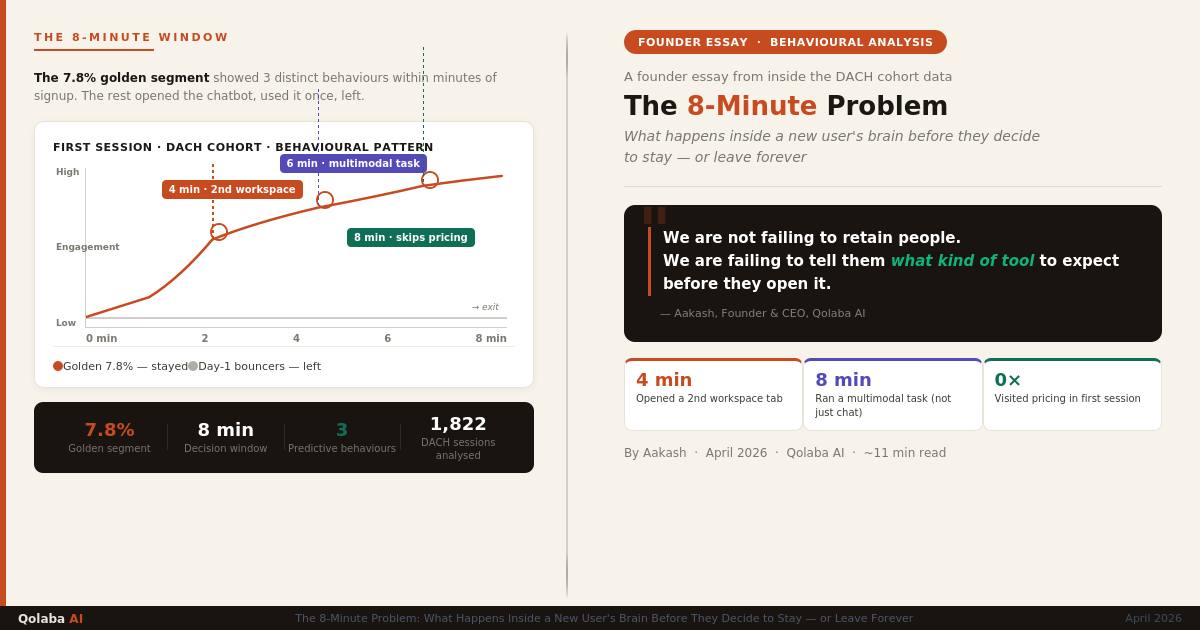
It is not the first hour. It is not even the first half hour. Looking at our DACH cohort session data over the past quarter, the moment when a new user’s brain decides whether this tool will be part of their life or will be permanently abandoned arrives in a window roughly 8 minutes after first signup.
This is the 8-minute problem. It is not a problem most SaaS companies are looking at, because the metrics we have been trained to watch are weeks too coarse to see it. By the time someone has not returned on Day 7, the decision was made on Day 1 at minute 8.
I want to share what we found when we actually looked at that window.
What the Data Showed — The 7.8% Golden Segment
I went through three months of new-user session data from our DACH cohort. Specifically, I was looking for differences in early-session behaviour between users who returned to Qolaba within 7 days and users who never came back.
The retention split was unremarkable: industry-typical Day-1 to Day-7 falloff. What was interesting was not the headline number but the behavioural pattern hiding inside it.
A specific subset of users about 7.8% of new signups showed three distinct behaviours during their first session, all clustered within the first 8 minutes. This group had dramatically higher Day-7 retention than the rest of the cohort. Not slightly higher. Categorically different.
Here is what the golden 7.8% did:
They opened a second workspace tab within 4 minutes
Not a second chat. A second workspace. They navigated away from the default chat interface, explored what else existed in the product, and opened a parallel context a separate workspace, a knowledge base view, a model gallery. The action says: I am evaluating this as a thing with multiple parts, not as a single interaction.
They ran a multimodal task within 8 minutes
Not just a text prompt. They either generated an image, ran a translation against an uploaded document, attached a file, or used a code execution sandbox. They used Qolaba as something other than a chatbot within the first 8 minutes of meeting it.
They never once visited the pricing page during their first session
This one surprised me. I expected the opposite that engaged users would check pricing because they were considering whether to keep using the product. The data showed the inverse. Users who visited /pricing in their first session were significantly less likely to return. Users who stayed inside the product environment for the entire first session, never breaking the spell to evaluate cost, were the ones who came back.
The 7.8% who exhibited all three behaviours had Day-7 retention dramatically above the cohort average. Not 2x higher. Not 3x higher. Categorically different from the rest of the cohort. They had crossed some kind of threshold the rest had not.
What the Day-1 Bouncers Did
The flip side is more sobering. The largest segment of new signups by far exhibited a near-identical session pattern:
Open the chatbot. Write one prompt. Get one output. Close the tab.
That is the entire session. Median duration: under 4 minutes. The user opened Qolaba, treated it as a chatbot, used it for a single chatbot-shaped task, got an answer that was either good or bad, and left.
Whether the output was good or bad turned out to be almost irrelevant to whether they returned. The output quality was downstream of a more fundamental issue: they had never seen the rest of the product. They had no idea workspaces existed. They did not know multimodal tasks were possible. They did not know there was a knowledge base feature. They opened a chatbot, used the chatbot, and left having had a chatbot experience.
If they came back at all, they came back for another chatbot task. And ChatGPT is free and faster for that. So they did not come back.
The Insight That Was Uncomfortable to Sit With
The first instinct, when you see this data, is to fix the onboarding flow. Add a tooltip pointing at workspaces. Add a guided tour. Force users to click through three feature explanations before reaching the chat interface. Make them attach a file. Make them open a second workspace. Engineer the behaviour you want.
This is the wrong response. I have watched it fail.
The behaviours of the 7.8% are not the cause of their retention. They are a symptom of something more upstream. Those users opened a second workspace within 4 minutes because they came in expecting a workspace. They ran a multimodal task within 8 minutes because they came in expecting multimodality. They did not visit pricing because they had already decided they were evaluating something serious enough that cost was a later question.
The users who treated Qolaba like a chatbot came in expecting a chatbot. And once you have framed the encounter that way in your own head, no amount of feature discovery in minute 9 can rewind your mental model of what the product is.
The 8-minute window is not when the product convinces the user. It is when the user finishes interpreting their own expectation. The expectation was set before they opened the product. We just got to find out, in real time, what they had already decided.
The Reframe — This Is Not an Onboarding Problem, It Is a Positioning Problem
When I sat with this data long enough, I had to admit something uncomfortable: we have been solving the wrong problem.
I have spent more meetings than I can count discussing onboarding flow improvements. Activation funnels. Tooltip placement. Email drip sequences for new signups. Hot Jar recordings. All of these things assume that the user arrived with no expectation of what Qolaba is, and that our job is to teach them in the first 8 minutes.
The data says the opposite. The user arrived with a fully-formed expectation of what Qolaba is. They got that expectation from somewhere our landing page, an ad, a tweet, a comparison article, a friend’s offhand mention. By the time they signed up, they already knew (or thought they knew) what category of tool they were about to use. The first 8 minutes was them confirming, not discovering.
If they confirmed “this is a chatbot,” they used it like a chatbot and they left.
If they confirmed “this is a workspace,” they used it like a workspace and they stayed.
The expectation was the dependent variable. The product behaviour was the independent variable. We had them backwards.
This is a positioning problem, not an onboarding problem. We have not been failing to retain people. We have been failing to tell them what kind of tool to expect before they open it.
What This Means for Founders
I want to be careful here because the temptation, when you discover a framing this clean, is to overgeneralise it. Not every product has an 8-minute problem. Not every retention failure is a positioning failure. The behavioural pattern I observed is specific to a particular kind of tool one where the user has a strong prior expectation, where multiple competing category metaphors exist (chatbot vs. workspace vs. AI assistant), and where the first session is the only session you usually get.
But if you are a founder reading this and the description fits your product if you have users who churn after one session, if your retention curve looks healthy on aggregate but the first-session conversion is the bottleneck the question to ask is not “what should our onboarding teach them?” The question is:
What does someone who has never heard of us think we are before they click sign-up?
If the answer is “I don’t know, the landing page is kind of broad,” that is probably the actual problem. The landing page is the only place where you control the expectation. The 8 minutes after signup is where the user confirms or contradicts what the landing page told them. If the landing page set the wrong expectation, no onboarding tour can fix it inside those 8 minutes.
What We Did About It — Briefly
I want to share this last part briefly because the point of this essay is not really to talk about Qolaba’s positioning evolution. But for the founders reading and asking “fine, what did you change?”:
We stopped describing Qolaba as “200+ AI models in one place.” That phrasing reinforced the chatbot frame many models, but the relationship to each model is a chat interface. We started describing Qolaba as “an AI workspace” with model access being one feature among several. The shift was small in words and large in mental model.
We restructured the landing page above-the-fold to show what a workspace looks like multiple contexts, a knowledge base, an agent before mentioning the model count. We moved the model gallery from primary navigation to a feature page. We added language that specifically framed the encounter: “Treat it like a workspace, not a chatbot, and the first 8 minutes will surprise you.”
The early signal from the data after these changes was encouraging but I am not going to put numbers on it yet because the sample size is too small to be honest about. What I will say is that the percentage of users opening a second workspace within 4 minutes has moved meaningfully in the direction we expected.
That is the only validation I trust. The behaviour the 7.8% exhibited spontaneously, more users are now exhibiting because the framing primed them to.
The Uncomfortable Question
If you are a SaaS founder reading this, here is the question I would want a thoughtful peer to ask me:
What expectation are your new users arriving with and is it the expectation you would choose if you had the choice?
If you are honest about that question, you are probably already most of the way to the answer. The 8-minute problem is not really an 8-minute problem. It is the consequence of every positioning choice you made before that user clicked your signup link.
The first session is not where the user decides whether to stay. It is where they find out whether you described yourself accurately.
People Also Ask
What is Day-1 retention in SaaS?
Day-1 retention is the percentage of new users who return to the product within 24 hours of first signup. It is widely used as a proxy metric for product-market fit in consumer and prosumer SaaS, but it can mask important behavioural variation. The decision to return is typically made within the first session — often within the first 5–10 minutes — meaning Day-1 retention is the downstream symptom of an earlier, much shorter window.
How long is the first session window for SaaS retention?
Based on session behaviour analysis of Qolaba’s DACH cohort, the critical decision window for whether a new user will return is approximately 8 minutes after first signup. The specific behaviours users exhibit in this window correlate strongly with Day-7 retention. Users who exhibit three specific behaviours opening a second workspace tab within 4 minutes, running a multimodal task within 8 minutes, and not visiting the pricing page during their first session show dramatically higher retention than the cohort average.
Is onboarding or positioning the bigger driver of SaaS retention?
For products where users have a strong prior expectation of what category the tool belongs to, positioning is typically the larger driver. Users who arrive expecting a chatbot will use the product like a chatbot regardless of what the onboarding flow shows them. Users who arrive expecting a workspace will explore workspace features within the first 8 minutes without prompting. Onboarding flows can reinforce a positioning choice but rarely override an incorrect one set on the landing page.
Why do users churn after one session in SaaS products?
The most common cause is expectation mismatch the user arrived expecting one category of tool, encountered behaviour consistent with their expectation, completed one task in that mode, and left because the product matched their expectation but did not exceed it. The fix is rarely better onboarding. It is more often a positioning change upstream of the signup decision, so that the user arrives with an expectation that maps to the product’s actual strengths.
Should SaaS companies optimise for first-session activation or longer-term engagement?
Based on the behavioural pattern observed, first-session activation is downstream of an earlier choice: what expectation does your positioning set? Optimising onboarding flows without revisiting positioning typically yields marginal improvements. Revisiting positioning to align user expectations with the product’s actual category typically produces categorical shifts in retention.
The 8-minute window is the median timestamp at which key behavioural indicators correlated with Day-7 retention. The number is specific to Qolaba’s DACH cohort behaviour and the product’s interaction patterns. Other SaaS products will have different windows — but the principle that there is a specific minute-scale window inside Day-1 where the decision is made likely generalises.
Yes. The reframe from “onboarding problem” to “positioning problem” came partly from session data and partly from interviews with users in both the staying segment and the bounced segment. The interview signal supported the data signal users who stayed described Qolaba in workspace language unprompted. Users who bounced described it in chatbot language unprompted. The expectation was already set before they opened the product.
Any product where multiple competing category metaphors exist and where the first session is the only session you usually get likely has an equivalent of the 8-minute problem. Notion went through a similar arc (notes app vs. workspace). Figma went through it (drawing tool vs. collaborative design platform). The specific window will differ. The structural problem will not.
Try Qolaba Free No Credit Card Required
400 credits on signup. Every AI model you need, in one workspace.
Start free at qolaba.ai285,000+ users · 100+ countries · DSGVO-compliant
Aakash
Founder & CEO of Qolaba AI — an AI Operating System that consolidates 200+ AI models into one unified workspace with transparent credit pricing, persistent project workspaces, and DSGVO-defensible team controls. Qolaba serves 285,000+ users across 100+ countries.