
A Composite Case, Built From Real Patterns
Before going further: the case described in this article is a composite. It is built from patterns we have observed across DACH cohort behaviour involving Mittelstand companies, particularly Familienunternehmen in the 50-to-500-employee range. No single real company appears in the case below. Every detail in the case has a real counterpart in the data we have looked at; the specific combination is composite.
We label it clearly because honest scope is part of what the Mittelstand respects.
The composite: a three-generation family manufacturing business in Baden-Württemberg. Around 80 employees. The grandfather founded the company in 1962. The father took over in the late 1990s and runs it today as Geschäftsführer. His daughter, now in her mid-thirties, works as the de facto operations lead and is being prepared as the next generation. They make precision components for industrial automation. They have customers in Switzerland, Austria, and northern Italy. Their internal language is a mix of Schwäbisch in the workshop, Hochdeutsch in the office, and English on calls with the Italian customers.
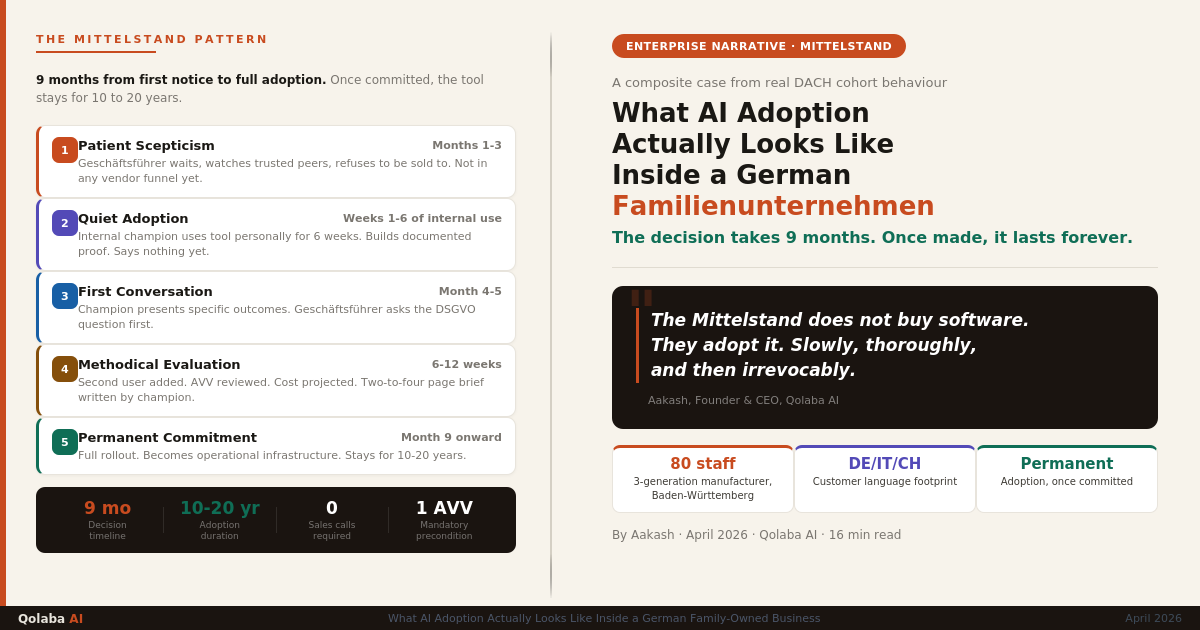
This is the company evaluating AI tools. The process took nine months. The pattern is recognisable.
Stage 1: The Geschäftsführer Has Been Burned Before
The first thing to understand about a Mittelstand decision-maker is that they have been burned. Specifically, they have been burned by software that was sold to them in 2014, 2018, and 2021 with similar promises. Most of those tools are no longer used. Some of them are still being paid for because nobody got around to cancelling. The Geschäftsführer remembers each of those purchases. The institutional memory is long.
When the AI conversation arrives in 2025 or 2026, the initial response is not enthusiasm. It is a particular kind of patient scepticism. The Geschäftsführer is not against new tools. He has bought new tools many times. What he is against is being sold to with the same energy that sold him the 2018 tool that did not work.
In our composite case: the daughter mentions ChatGPT to her father in early 2026. He nods politely. He has read the newspaper articles. He understands AI is significant. He is not, however, going to be the family business that ran out and bought every AI tool that appeared. He waits.
The waiting is not passivity. It is a specific evaluation posture. He wants to see what the responsible early adopters in his industry network do first. He wants to see who adopts, who quietly stops using it, and who, after eighteen months, has produced a documented outcome they can describe at the industry association meeting. He is not waiting for a sales pitch. He is waiting for proof from people he trusts.
This phase can last six months on its own. It is not visible in any tool vendor’s funnel. The Mittelstand is not in the funnel yet.
Stage 2: The Internal Champion Adopts Quietly
While the Geschäftsführer waits, something else happens. Inside the company, somebody starts using AI tools personally. Not the founder. Usually not the senior managers. The person who picks it up first is in the middle of the org chart: an operations manager, a project coordinator, a senior administrator, the controller, sometimes the founder’s daughter or son who has just joined the business after a few years at a larger company.
In our composite case: the daughter. She used ChatGPT and Claude during her previous job at a Berlin consultancy. When she joined the family business, she did not bring up AI tools in any management meeting. She kept using them personally for her own work: drafting customer emails in three languages (German, Italian, English), preparing meeting notes, organising her own knowledge management.
She did this for six weeks before mentioning it to anyone.
Six weeks is the magic number we see consistently in DACH Mittelstand behaviour. Long enough to develop personal competence. Long enough to know what the tool actually does versus what marketing claims it does. Long enough to have built up specific examples of where it worked and where it failed. The internal champion is not going to walk into the Geschäftsführer’s office and say “I tried this tool, it seems good.” They are going to walk in after six weeks and say “Here are three specific things I have been doing differently for the past month, and here is what changed.”
The internal champion in a Mittelstand evaluation is doing something American startup observers often miss: they are building proof before asking permission. They know that asking the Geschäftsführer to evaluate a tool he has not seen working is asking him to repeat past mistakes. They know that showing him a tool that has already produced six weeks of documented outcomes is asking him to look at evidence.
This is the same evaluation posture the Geschäftsführer is using. The champion has learned it by watching how decisions actually get made in this kind of business.
Stage 3: The First Conversation
After about six weeks, the internal champion brings it up. Usually not in a formal meeting. Often during a Friday afternoon walk through the workshop, or over coffee, or in the car on the way back from a customer visit. The casualness of the venue is deliberate. The Geschäftsführer does not want to be sold to. He wants to hear something that sounds like a peer-to-peer observation.
The champion describes specifically what they have been doing. Not what the tool can do in theory. What they have been doing in practice. In our composite case: “I have been writing the initial draft of customer emails using Claude, then editing them. The Italian emails used to take me forty minutes each. They now take me ten. I have been doing this for six weeks. I can show you the email log.”
The Geschäftsführer asks specific questions. Not feature questions. Outcome questions. What customers responded faster? Did any of them notice a difference in tone? Have you ever sent a draft that contained a mistake? What did you do when that happened? How do you know the tool is not sending your customer information somewhere you cannot control?
The last question is the DSGVO question, and it is not optional. A Mittelstand evaluation cannot proceed without a clear, defensible answer to the data handling question. The internal champion has already prepared for this. They have already checked whether the tool offers an Auftragsverarbeitungsvertrag. They have already looked at whether the data goes to EU servers or US servers. They have already decided whether the answer is good enough that they would feel comfortable defending it to a customer’s compliance team.
If the answers to the outcome questions and the data handling questions are good, the Geschäftsführer says some version of: “Let’s look at it more formally.”
That sentence is the actual start of the procurement process. Everything before it was prologue.
Stage 4: The Methodical Evaluation
The methodical evaluation phase is what most software vendors completely misread. It is not a free trial in the SaaS sense. It is not a pilot in the enterprise sense. It is something in between, with characteristics specific to Familienunternehmen evaluation.
The evaluation phase typically lasts six to twelve weeks. During this time, the following happens, almost always in this order:
The internal champion expands usage. What they were doing personally for six weeks, they now do with documentation. Every workflow change is captured. Time savings are measured concretely (the email used to take forty minutes; it now takes ten). Errors are tracked. Customer responses are categorised.
A second team member is added. Usually someone the champion trusts who works in an adjacent function. In our composite case: the office manager, who handles much of the Italian and Swiss customer correspondence. She is given a personal account and four weeks to use the tool the same way the daughter has been using it. Her experience is recorded separately, so the evaluation has two independent data points rather than one.
The Geschäftsführer reads a brief at the end of the methodical evaluation phase. The brief is usually two to four pages, written by the internal champion. It contains: what was tried, what worked, what did not work, what the measured time savings are, what the credit costs would be at full team adoption, what the DSGVO position is, what the contractual position is (data processing agreement, data residency, termination terms), and what the implementation plan would look like if the company committed.
The Geschäftsführer reads the brief. Often he reads it twice, several days apart. He asks specific questions, usually of the contractual and DSGVO type, because those are the questions a Familienunternehmen Geschäftsführer is responsible for and cannot delegate.
He often asks his Steuerberater (tax advisor) to review the cost projection. Sometimes he asks the Datenschutzbeauftragter (data protection officer, internal or external) to review the data handling. These are not procurement gates. They are advisor consultations of the kind a Mittelstand Geschäftsführer uses for any meaningful decision.
Then he makes a decision. The decision is usually one of three: not now, yes proceed, or yes proceed with these specific conditions. The third option is the most common.
Stage 5: Full Commitment, Permanent Adoption
When a Mittelstand company commits, the commitment is real. This is where the buying behaviour diverges most sharply from American or even Berlin-startup behaviour.
A startup that adopts a tool will likely switch tools within eighteen months. A Mittelstand company that adopts a tool will use it for the next ten years, possibly the next twenty. The tool becomes part of the company’s operational infrastructure. New employees are trained on it as part of onboarding. Workflows are designed around it. The institutional knowledge of how to use it accumulates.
In our composite case: by the end of month nine, the family business adopted Qolaba across the company. Six users in production. The internal champion (the daughter) became the de facto admin. The Geschäftsführer himself uses it personally for one specific workflow: writing the formal letters that go out to long-standing customers on the occasion of significant moments (anniversaries, major orders, retirements). He prefers the drafts that come from a careful AI assistant to the drafts that come from his own first attempts; it gives him a baseline he can edit toward his own voice.
He has not told his industry network. He probably will not, except in answer to direct questions. Mittelstand companies are not loud about their tools. They use them, they renew them, and they go quiet about them because in their industry context, talking about your tools too much can be read as either bragging or insecurity.
This is also why most software vendors do not realise how strong a position a Mittelstand account represents. The Mittelstand customer does not become a logo on a customer wall. They do not produce case studies. They do not speak at conferences. They pay their invoices on time, they renew without negotiation, and they stay for years.
What This Means for Software Vendors Selling to the Mittelstand
If you sell software to Mittelstand companies, the implications of the above are worth taking seriously.
First, do not try to compress the timeline. The nine-month decision is not a problem to be solved. It is the actual evaluation process. Companies that try to compress Mittelstand evaluation timelines with discount offers, expiring trials, or urgency tactics damage their credibility, not their conversion rate.
Second, the internal champion is your actual customer. Not the Geschäftsführer. Find them. Make their job of building proof easier. Give them a free tier that produces results they can document. Give them concrete examples of how other operations managers, controllers, or daughter-being-trained-as-successor types in similar businesses have used the tool successfully.
Third, the DSGVO answer is not optional and cannot be vague. Mittelstand companies cannot adopt a tool that does not have a clean data processing agreement and a defensible position on data handling. This is not a marketing differentiator for them. It is a precondition.
Fourth, do not interrupt the methodical evaluation phase. If a Mittelstand prospect has gone quiet for six weeks, they are not lost. They are doing the work that the evaluation requires. The vendor’s job during this phase is to be available for specific questions, not to push for next steps. Pushing accelerates nothing and signals impatience that the Mittelstand reads correctly as inexperience.
Fifth, once they commit, treat the relationship as a fifteen-year relationship. They are. The annual price negotiations matter; the relationship matters more. Mittelstand companies remember who took care of them and who tried to extract them.
What This Means for the Mittelstand Operator Reading This
If you work inside a Mittelstand company and you have been quietly using AI tools for six weeks without telling your Geschäftsführer, you are doing it correctly. The process you are following is not eccentric. It is the same process your father probably used to evaluate the ERP system in 2003. The same process your grandfather probably used to evaluate the first computer in 1985.
The instinct to build proof before asking permission is not avoidance. It is responsible decision-making in a context where the wrong choice is costly and the right choice is permanent.
You are also probably underestimating how much trust the Geschäftsführer has in your judgment if you are positioned to make this kind of recommendation. The fact that they expect you to come with documentation and not just enthusiasm is itself a signal of respect. They are treating you the way they want to be treated. Reciprocate by doing the work the documentation deserves.
One specific tactical suggestion: when you bring the tool to the formal evaluation conversation, prepare the DSGVO answer first. Have the Auftragsverarbeitungsvertrag available. Know where the data is processed. Know who the data protection officer would talk to at the vendor. Do this before you bring the cost projection. The Geschäftsführer will be impressed that you led with the DSGVO question because it shows you understand the actual order of importance.
The Pattern, Stated Plainly
The Mittelstand does not buy software. They adopt it.
The difference matters. Buying is transactional. Adoption is structural. A buying decision asks: does this tool justify its cost over the next twelve months? An adoption decision asks: is this tool the right partner for the next ten years?
The nine-month evaluation timeline is not bureaucratic friction. It is the work of doing an adoption decision properly. The internal champion building proof before asking permission is not avoidance. It is responsible preparation. The methodical evaluation phase is not vendor torture. It is the process of building the documentation that a permanent adoption decision deserves.
When this process is respected by the software vendor, the Mittelstand becomes one of the strongest customer relationships in the market. When this process is rushed, ignored, or treated as a sales problem, the Mittelstand declines politely and keeps using their old tools for another fifteen years.
The vendors who understand this are quietly building the most resilient customer bases in the German B2B market. The vendors who do not understand it are looking at their pipeline reports and wondering why their German numbers are not moving.
A Note on Why This Article Exists
We have spent the last 18 months watching how German professionals adopt AI tools. The Mittelstand pattern is the most striking thing we have observed. It is also the pattern most underwritten by software vendors, because Mittelstand companies do not produce loud customer stories and they do not show up in trade press in the way that Berlin tech startups do.
We wrote this article because the most respectful thing we could do for the Mittelstand was to describe them accurately. Not to pitch them. Not to claim we understand them better than they understand themselves. Just to describe what we see, in case it is useful to other vendors who are trying to serve this market, and in case it is useful to the operators inside Mittelstand companies who are doing the work of figuring out whether AI tools belong in their business.
If you are a Mittelstand operator reading this and your Geschäftsführer is in the patient-scepticism phase: that is the right phase. Let it run its course. Build your proof carefully. The decision, when it comes, will last.
People Also Ask
How do German Mittelstand companies actually evaluate AI tools?
The evaluation typically takes nine months and follows a recognisable pattern. First, the Geschäftsführer waits to see how trusted peers in the industry network adopt similar tools. Meanwhile, an internal champion (often in the middle of the org chart, sometimes a next-generation family member) begins using the tool personally for about six weeks, building documented examples of what works. The champion then presents the tool to the Geschäftsführer with specific outcome data, not feature lists. A formal methodical evaluation phase follows, lasting six to twelve weeks, including DSGVO review, cost projection, and a written brief. Once committed, adoption is essentially permanent.
Why does selling software to the German Mittelstand take so long?
The Mittelstand timeline is not bureaucratic friction. It is the work of doing an adoption decision properly. Mittelstand companies are family-owned multi-generation businesses where the tool being adopted is expected to remain part of operational infrastructure for ten to twenty years. The nine-month evaluation timeline reflects the seriousness of that commitment. Compressing the timeline with urgency tactics damages vendor credibility and rarely accelerates the decision.
What is the role of DSGVO in Mittelstand AI tool adoption?
DSGVO is a precondition, not a feature. A Mittelstand company cannot adopt a tool that does not have a defensible Auftragsverarbeitungsvertrag (AVV) and a clean position on data handling. The Geschäftsführer is personally responsible for this and cannot delegate it. The most effective approach when presenting an AI tool to a Mittelstand Geschäftsführer is to lead with the DSGVO answer, not the cost projection.
Who is the actual decision-maker for AI tool adoption in a Familienunternehmen?
The Geschäftsführer signs off, but the decision is shaped by the internal champion who does the proof-building work. The internal champion is typically not in senior management. They are in the middle of the organisation: an operations manager, a project coordinator, a controller, a next-generation family member being prepared as successor. Vendors who want to sell into the Mittelstand should focus on enabling internal champions, not on persuading Geschäftsführer directly.
How long does Mittelstand tool adoption last once decided?
Once a Mittelstand company commits to a tool, adoption is essentially permanent. Mittelstand companies typically use tools for ten to twenty years, often longer. New employees are trained on the tool as part of onboarding. Workflows are designed around it. This is one reason Mittelstand customers represent some of the strongest customer relationships available in the German B2B market.
Frequently Asked Questions
Is the composite case in this article based on real Qolaba customers?
The composite case is built from patterns observed across DACH cohort behaviour involving multiple Mittelstand and Familienunternehmen customers. No single real company is described in the case. Every specific detail in the case has a real counterpart in the data we have looked at; the specific combination is composite. We label it clearly because honest scope is part of what the Mittelstand respects.
Does Qolaba offer an Auftragsverarbeitungsvertrag for Mittelstand customers?
The Qolaba Teams plan includes an Auftragsverarbeitungsvertrag (AVV) as required under DSGVO Article 28. The AVV is scoped to the Teams plan and the Business tier; it is not available for individual free or paid plans. Mittelstand customers evaluating Qolaba for organisational use typically need the Teams plan with AVV documentation to satisfy their data handling requirements.
What is the smallest Mittelstand company size where the patterns in this article apply?
The patterns described typically apply from about 20 employees upward, but they are most pronounced in companies between 50 and 500 employees. Below 20 employees, the decision process is often faster because the Geschäftsführer is closer to operational reality. Above 500 employees, the company often has formal IT and procurement processes that shape the evaluation differently. The 50-to-500 employee range is the classic Mittelstand pattern.
How can a software vendor accelerate Mittelstand adoption without disrespecting the process?
The honest answer is that you usually cannot. The nine-month timeline is doing real work. What you can do is make the internal champion’s job easier. Give them a free tier that produces documentable results in their first six weeks of personal use. Provide DSGVO documentation that they can hand to their Geschäftsführer without having to ask. Offer specific examples of how similar Mittelstand companies have used the tool. These supports do not compress the timeline. They do make the internal champion’s proof-building work more efficient.
If You Are an Internal Champion Reading This
The patient evaluation process is not yours to apologise for. It is yours to do well.
The vendors who deserve to sell into your Familienunternehmen will respect the timeline. The ones who do not respect the timeline are the ones who would have caused problems later anyway.
If you want to try Qolaba quietly for six weeks, you can. The free plan offers 400 credits when you sign up, no credit card required. That is enough credits to write thirty client emails in three languages, generate a few illustrations for an internal presentation, and translate a small handful of regulatory documents between German and Italian. Enough to know whether the tool fits your work.
Whether you eventually bring it to your Geschäftsführer is your decision, made on your timeline, after your evaluation.