
There is a whole cottage industry built on the idea that the secret to AI is the perfect prompt.
Prompt packs. Prompt courses. Threads titled “the only 47 prompts you will ever need,” which is 46 more than anyone has ever actually used.
I looked at our power-user cohort in Germany and Austria to find the prompt geniuses. The users who burned the most credits, across the most modalities, who stayed the longest. Surely these were the people with the immaculate prompts.
They were not. Not one of them is notable for clever wording.
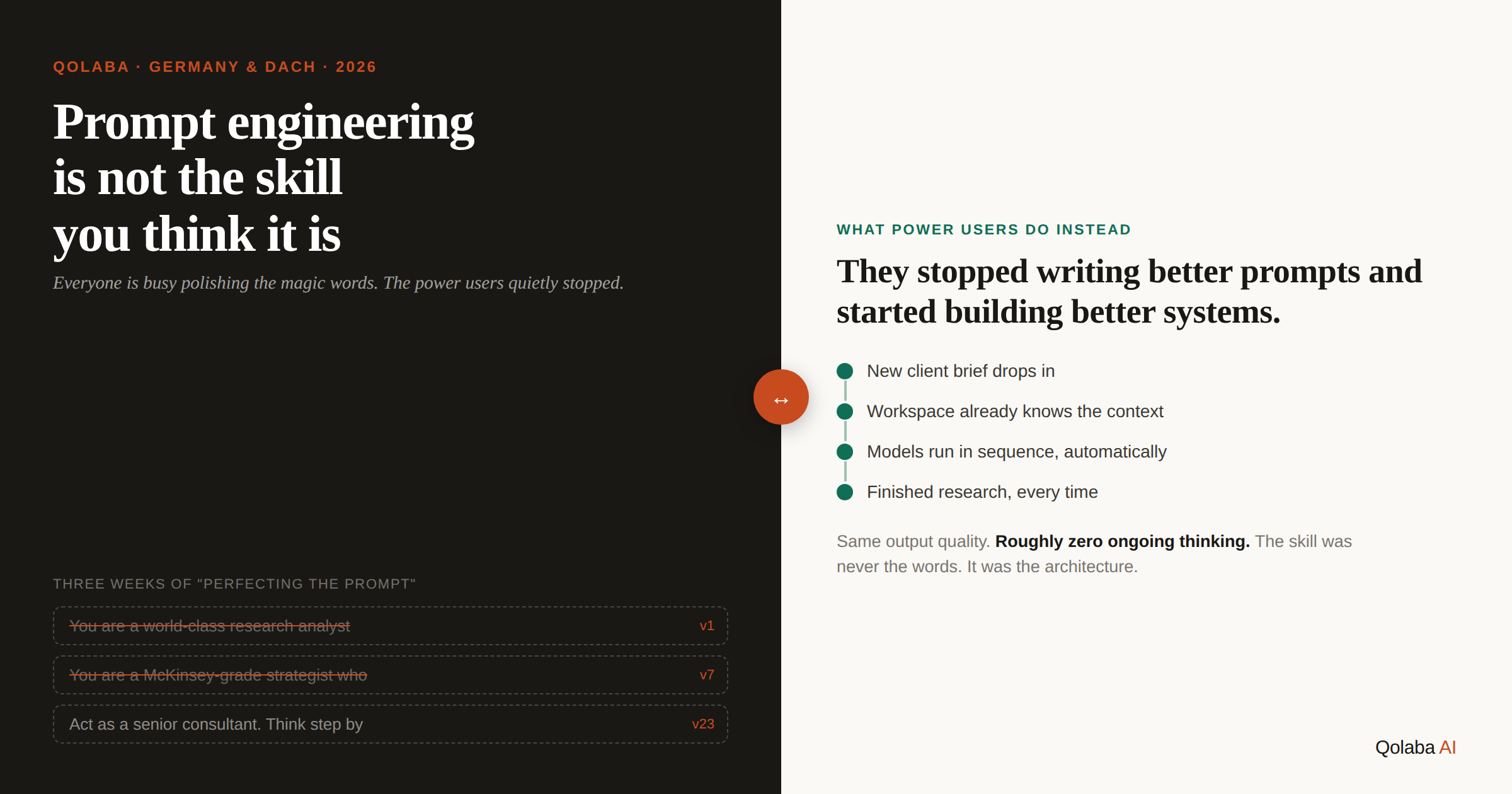
They are notable for something far less glamorous and far more useful: they design workflows. The magic was never in what they typed. It was in what they built so they would not have to keep typing it.
Prompt Thinking Asks a Question. Workflow Thinking Builds a Machine.
Here is the distinction the prompt-pack crowd never mentions, probably because it is bad for business.
Prompt thinking asks: “What do I say to get the output I want?”
Workflow thinking asks: “How do I build a system that produces good outputs without me having to think hard every time?”
Same goal. Completely different posture. One keeps you sitting in the loop forever, carefully feeding the machine by hand. The other quietly removes you from the loop, which, if we are honest, is the entire reason you wanted AI in the first place.
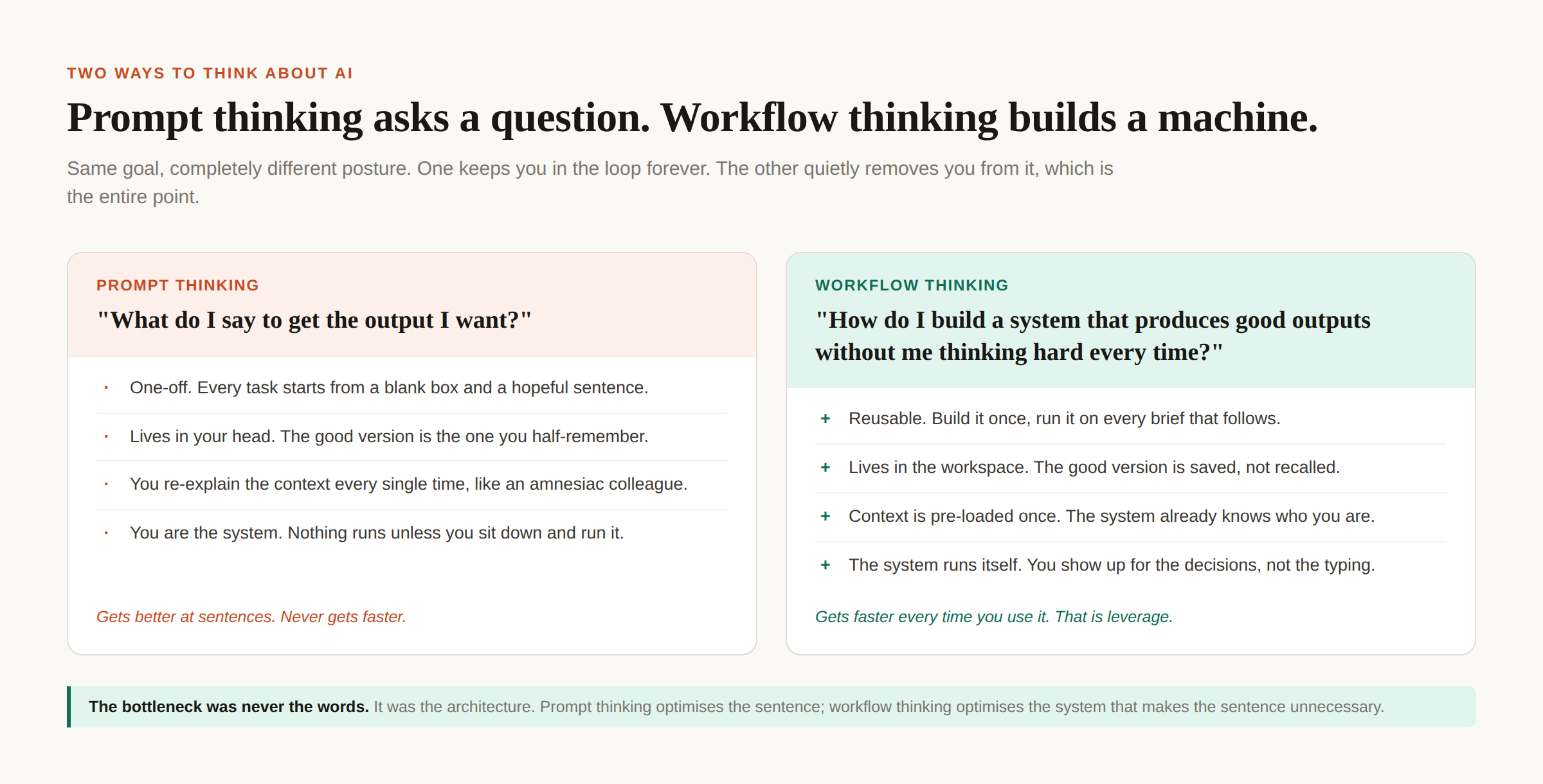 A perfect prompt is a lovely thing. It is also a one-off. You write it, you run it, and tomorrow you are back at the blank box doing it again, like a very advanced hamster on a very expensive wheel.
What the Power Users Actually Do (Spoiler: Not Prompts)
When you line up the heaviest, longest-tenured users and look for what they share, the same three moves show up every time. None of them is a prompt.
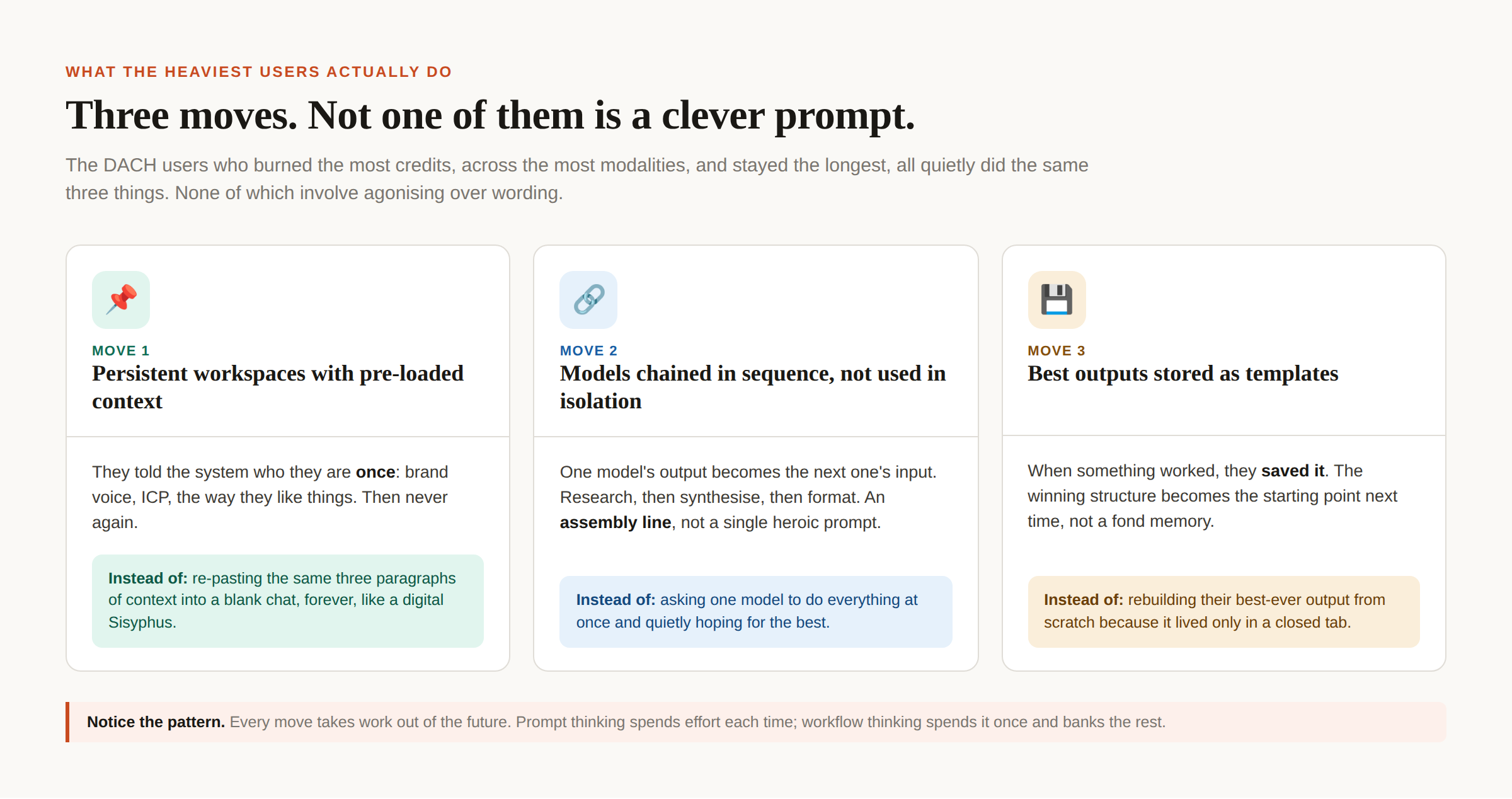
One. They built persistent workspaces with pre-loaded context. They told the system who they are exactly once: brand voice, ICP, the way they like things done. Then never again. No more pasting the same three paragraphs into a blank chat like a digital Sisyphus with a content calendar.
Two. They chained models in sequence instead of using them in isolation. One model’s output becomes the next one’s input. Research, then synthesise, then format. An assembly line, not a single heroic prompt asked to do everything at once while you cross your fingers.
Three. They saved their best outputs as templates. When something worked, they kept it. The winning structure becomes next week’s starting point, rather than a fond memory trapped in a tab they closed in March.
This is closer to being an AI agent builder than a prompt poet. The skill is wiring, not wording.
The Three-Week Prompt vs the Three-Hour Workflow
Let me make this painfully concrete with two consultants. Both real patterns, lightly fictionalised so nobody recognises themselves and emails me.
Consultant A spent three weeks perfecting a client-research prompt. And it is genuinely brilliant. Tuned, tested, beautiful. A sonnet of a prompt.
Consultant B spent three hours building a Qolaba workspace that runs the same research automatically on every new client brief.
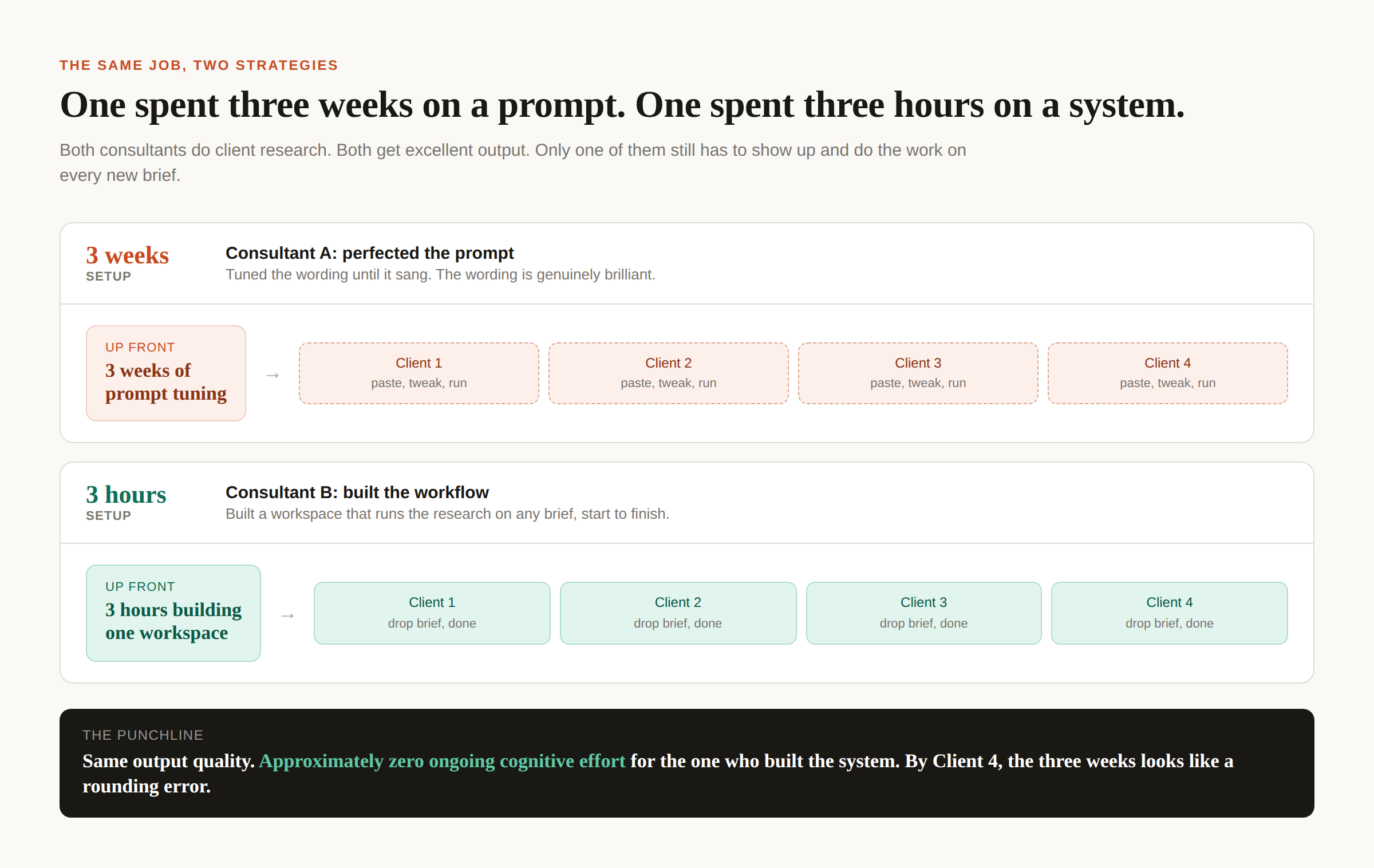
Same output quality. Truly, the work is comparable.
But Consultant A still has to show up, paste, tweak and supervise on every single brief, forever. Consultant B drops in the brief and goes to lunch. One built a skill. The other built a machine. The machine does not take lunch breaks, but it is very relaxed about you taking yours.
Prompts Cost You Every Time. Workflows Charge You Once.
Here is the part that should change how you spend your next free afternoon.
Effort on a prompt does not compound. However sharp the wording, you pay roughly full price on every task. The hundredth time is about as much work as the first.
Effort on a workflow compounds beautifully. You pay a big bill up front, the build, and then the cost per use falls off a cliff and stays there.
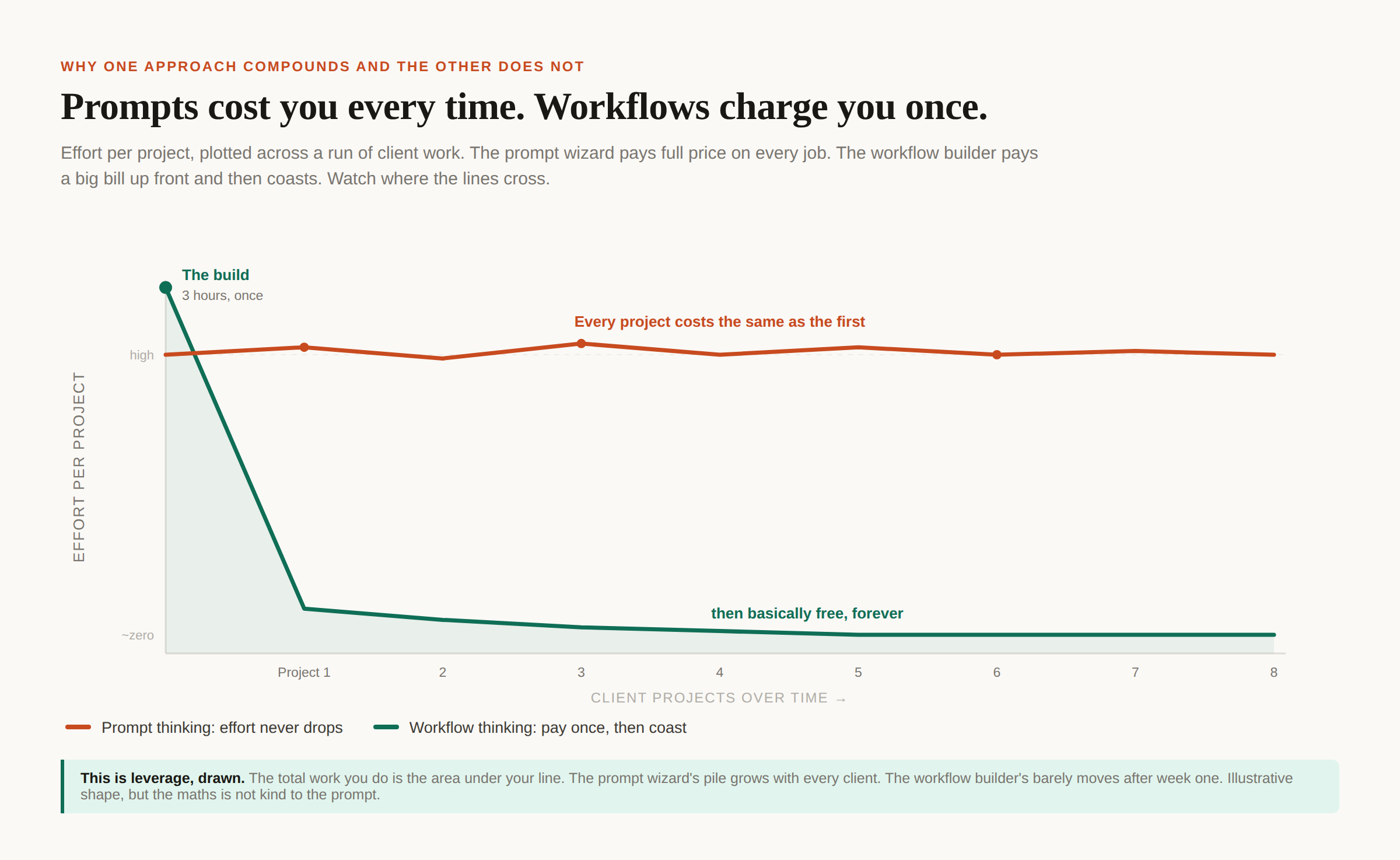
This is why “best prompt” is the wrong thing to chase and AI automation is the right one. A great prompt makes one task slightly easier. A great workflow makes a category of tasks disappear from your week.
It is also, conveniently, the cheaper path. The best AI tools for business are not the ones with the cleverest prompt library. They are the ones that let you build the system once and then get out of your way.
What a Workflow Actually Looks Like
“Workflow” sounds abstract and slightly corporate, like something that comes with a mandatory webinar. It is not. It is just an assembly line you build once.
Here is Consultant B’s client-research workflow, drawn out. A brief goes in one end. Finished, on-brand research comes out the other. The models run the relay in between.
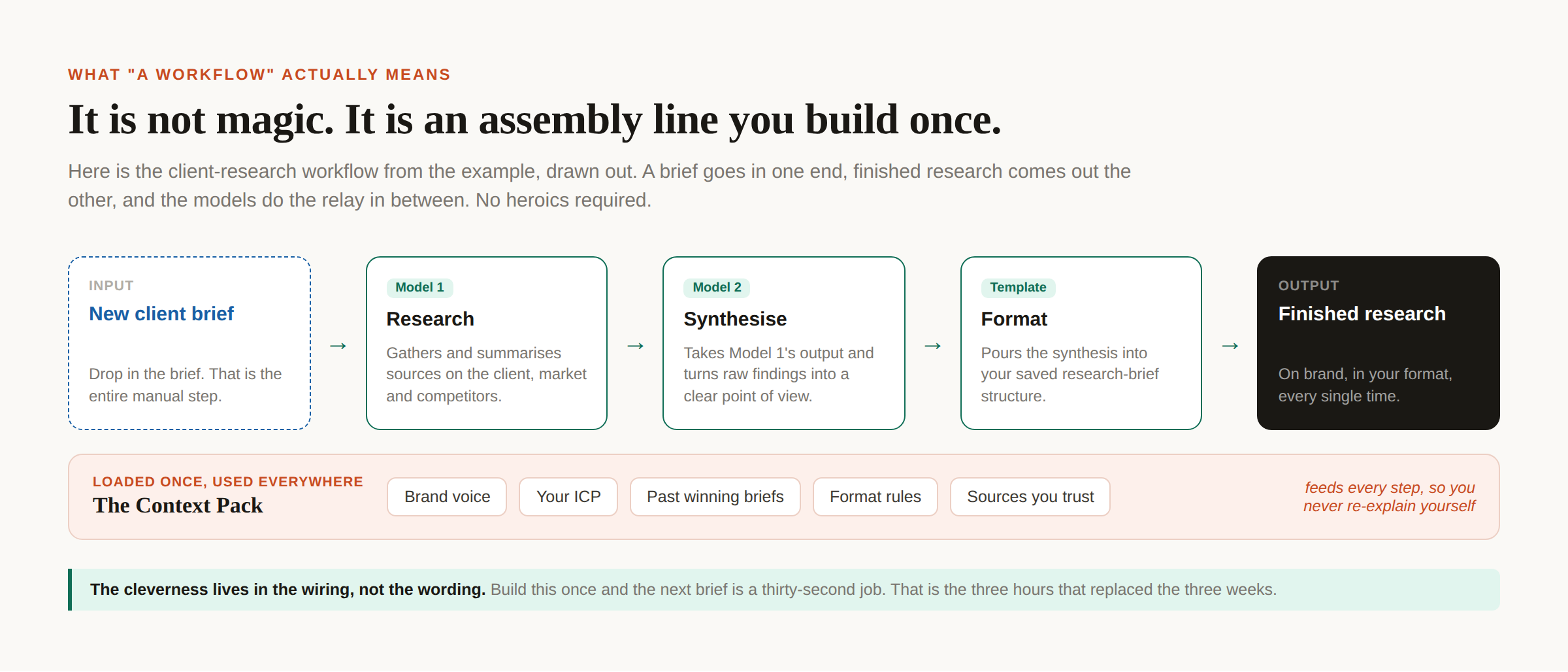
The trick is letting each model do one job and hand off to the next, all fed by a context pack you load once. This is the bit people mean when they talk about an all in one AI platform: not “many tools in one bill,” but “many steps in one place, talking to each other.”
And no, you do not need to code. On a no-code workspace you are pointing and connecting, not writing software. If you can describe the steps to a new hire, you can build the workflow.
Build Your First Workflow in 30 Minutes
Enough theory. The fastest way to believe any of this is to build one and watch it work. You need thirty minutes and one annoyingly repetitive task.
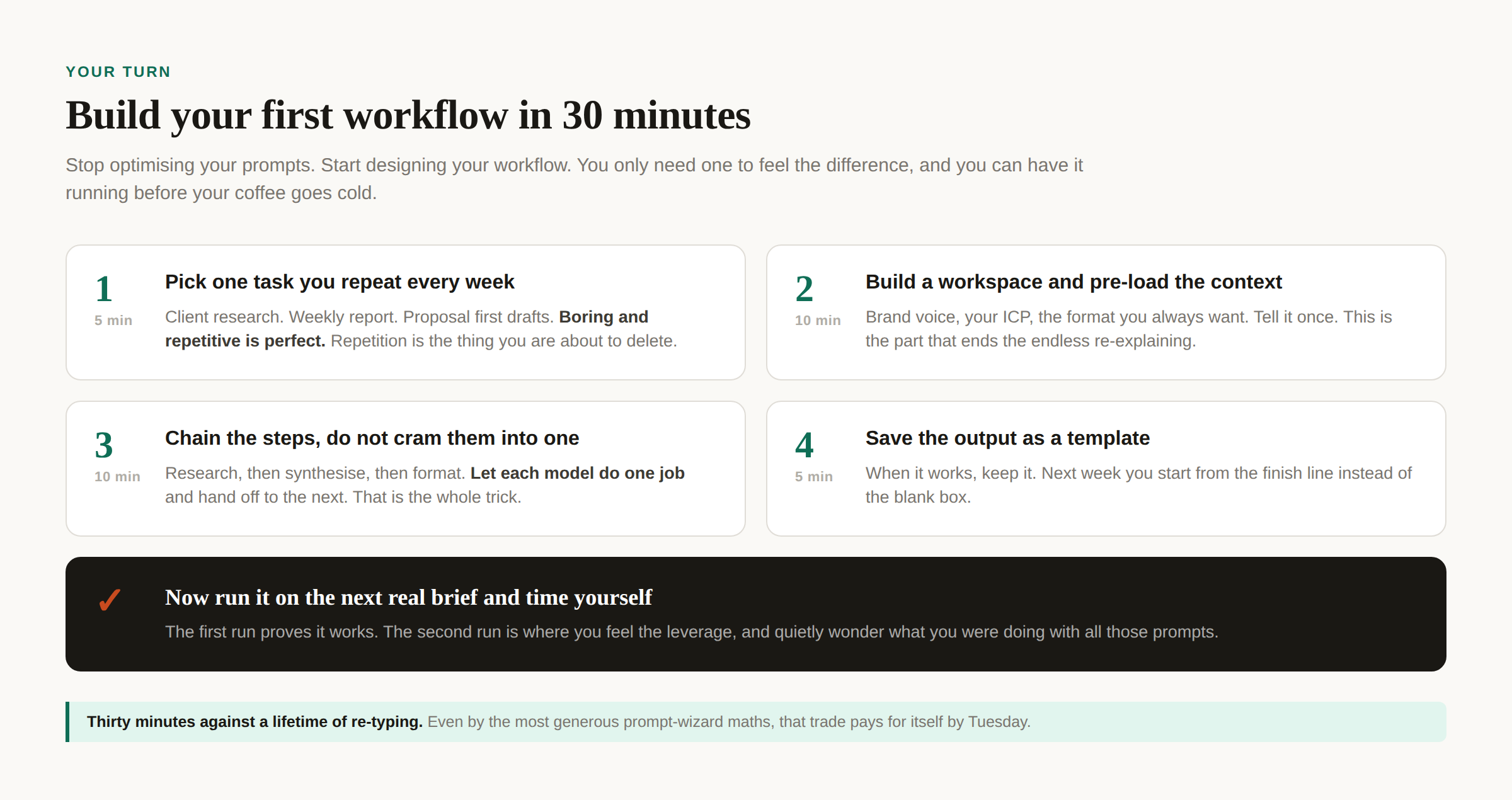
Pick the task that is boring, weekly and high-value. Client research. The recurring report. Proposal first drafts. The more often you grind through it by hand, the better.
Then build the workspace, pre-load the context, chain the steps, and save the result as a template. That is the whole thing. The first run proves it works; the second run is where you feel the leverage and quietly resent every prompt thread you ever bookmarked.
“Stop optimising your prompts. Start designing your workflow. The prompt makes today easier. The workflow makes the next hundred days easier, and then mostly forgets you exist, which is the goal.”
What Founders and Consultants Found When They Switched
From the Qollective community and a few DACH founder forums, where people are refreshingly blunt about what actually changed.
“I had a prompt I was genuinely proud of. Spent ages on it. Then I rebuilt it as a three-step workflow with my client context pre-loaded, and now onboarding research for a new client takes ten minutes instead of half a day. The prompt was a trophy. The workflow is a colleague.”
“As a founder I do not have time to be a prompt artisan. I built one workflow for our weekly market research and one for content first drafts. That is it. Two systems quietly running in the background bought me back roughly a day a week. I have no idea what the optimal prompt would have been and I no longer care.”
“The unlock was chaining models instead of asking one to do everything. My old mega-prompt was a circus act. Splitting it into research, then synthesis, then format made the output better and meant I stopped editing every single time. I did not get better at prompting. I got better at not needing to.”