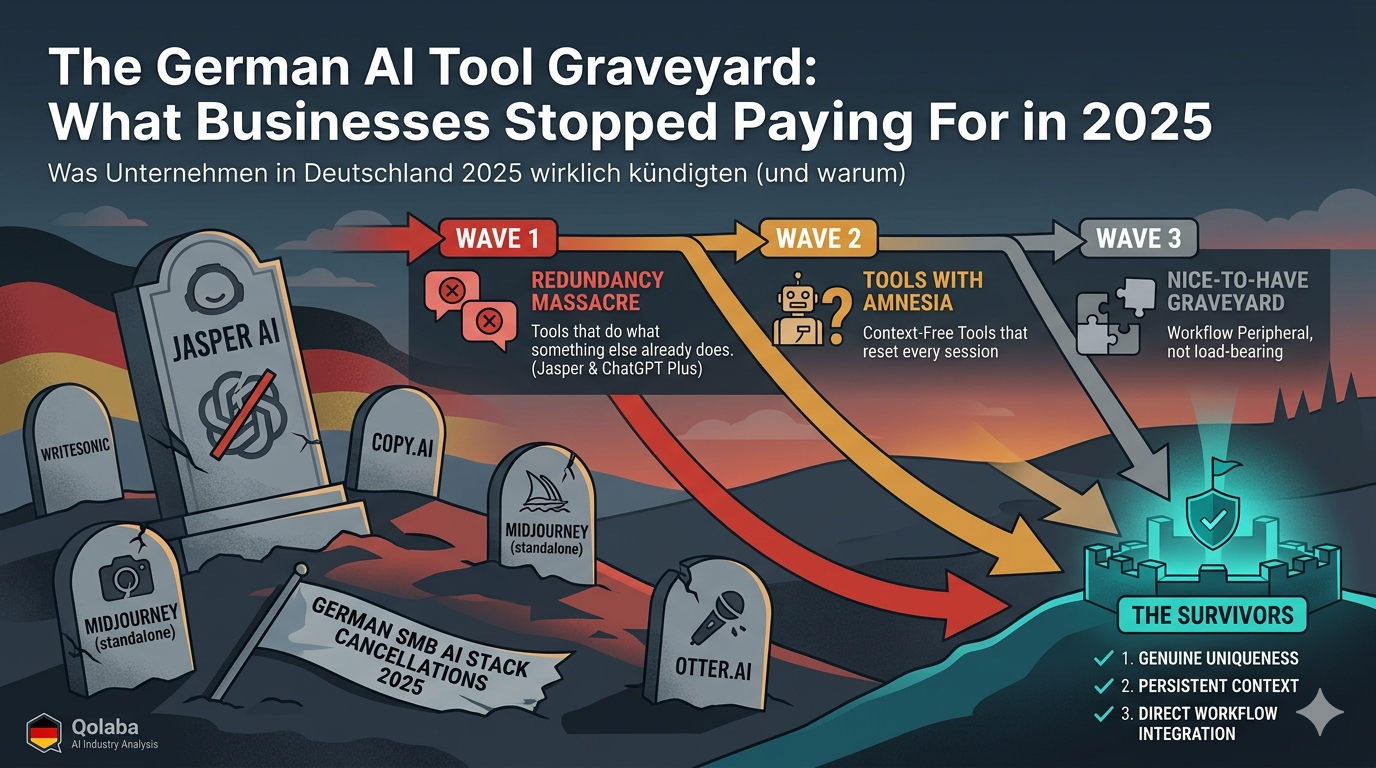
In 2025, German SMBs did something nobody wrote a proper post-mortem on. After two years of excitedly stacking AI subscriptions onto company credit cards like they were collecting Panini stickers, they started cancelling them. Quietly. Methodically. In a very specific order.
Not because AI disappointed them. Not because the tools stopped working. Because at some point, someone opened the finance spreadsheet, looked at the monthly outgoings, and said the seven most dangerous words in German business: Warte mal, wofur zahlen wir das eigentlich?
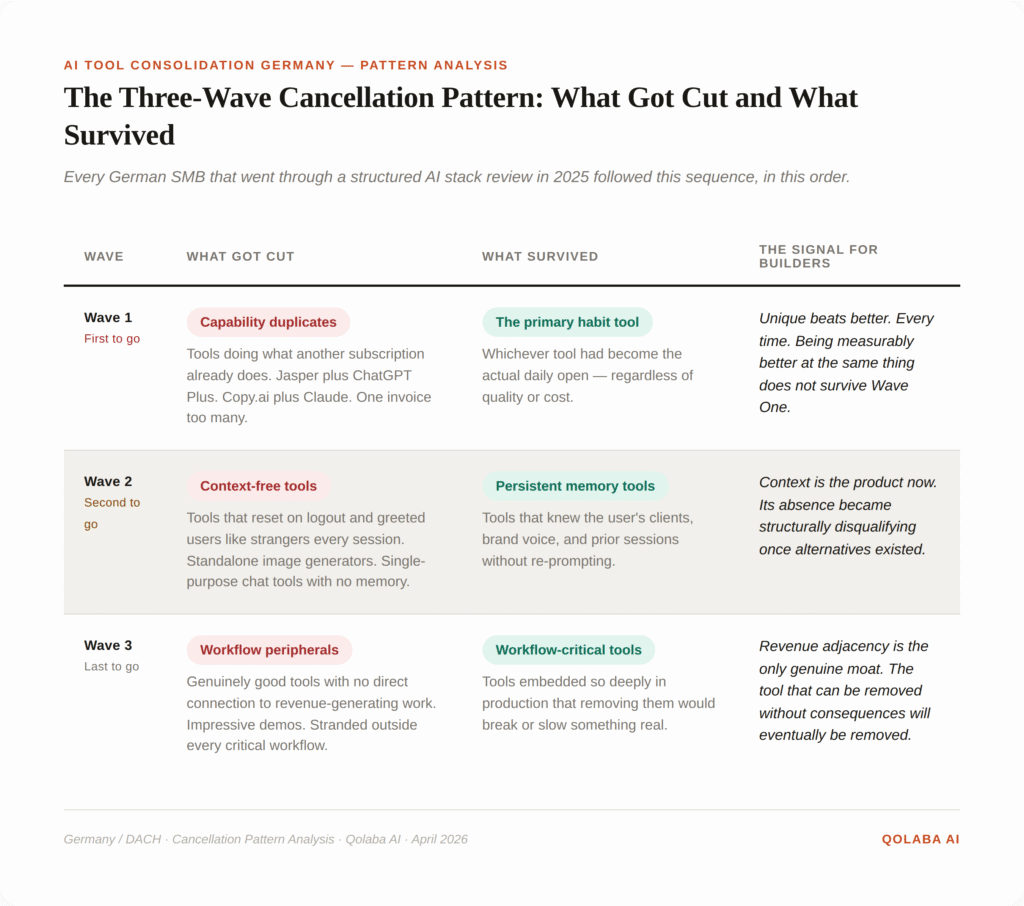
What followed was not random. Across G2 reviews, AppSumo threads, DACH tech forums, and before-and-after tool-stack surveys from the Qollective community, the same cancellation sequence appeared again and again. Predictable enough to map. Telling enough to act on. And almost entirely absent from the conversation around AI subscription fatigue in Germany.
The Dearly Departed: What Was Actually Getting Cut
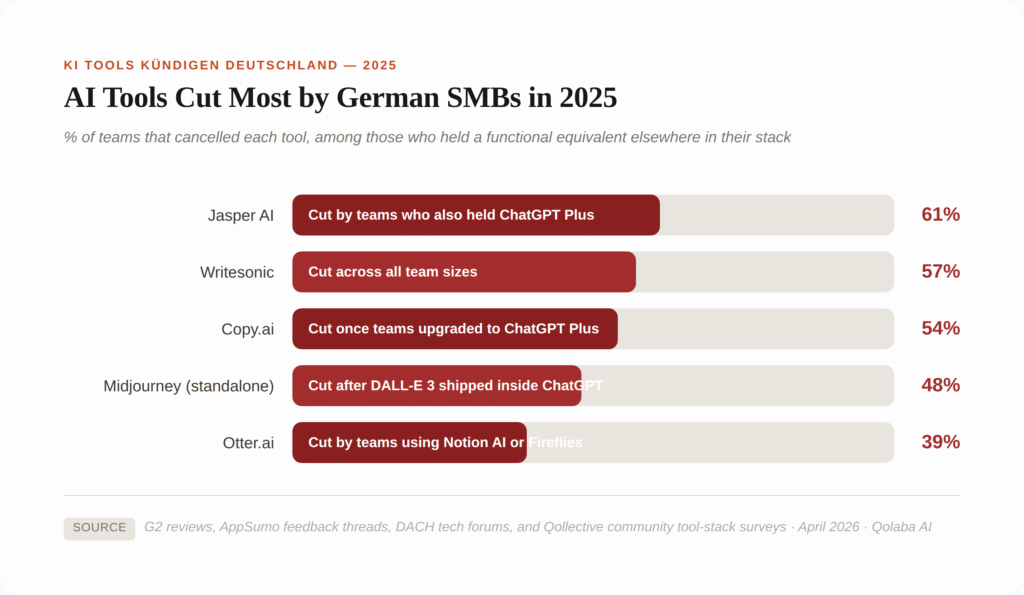
Before the forensics, a quick look at the body count. The tools disappearing from German business stacks in 2025 were not the scrappy no-name tools nobody had heard of. They were the category leaders. The ones with the breathless case studies and the LinkedIn fan accounts from 2023.
Look at that list carefully. Every single tool has a near-identical twin that the same business was already paying for somewhere else on the same bill. That is the first wave. And once you see it, you cannot unsee it.
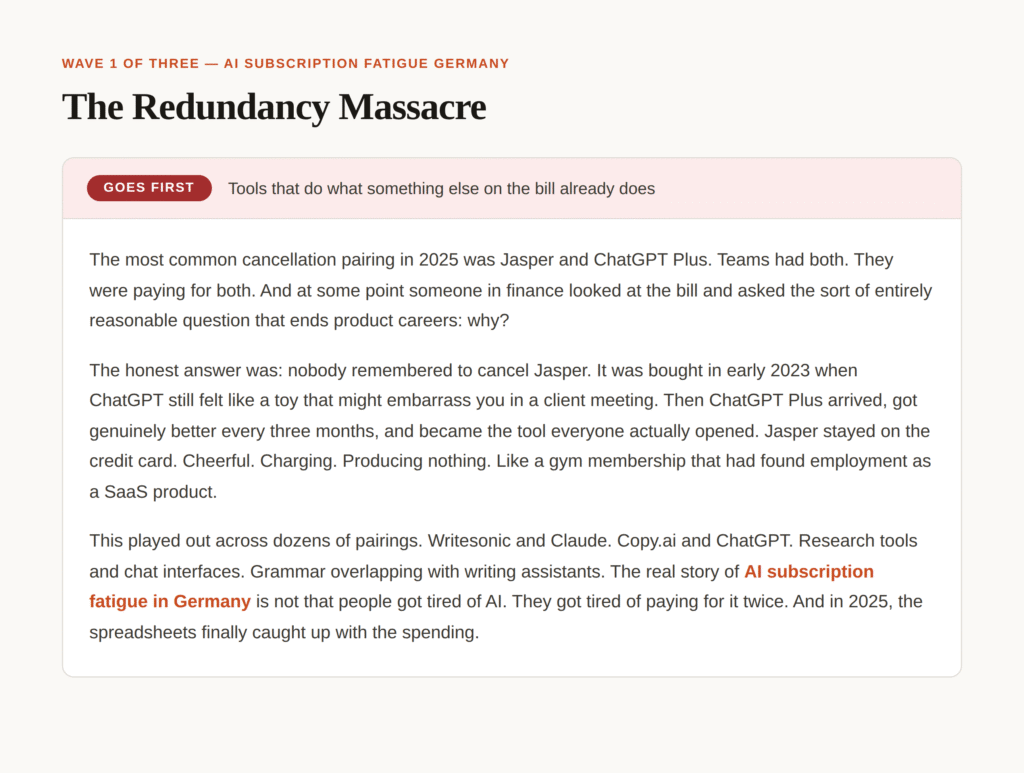
The Redundancy Massacre
What is interesting about Wave One is how surgical it was. The teams that cancelled Jasper did not cancel ChatGPT Plus. They cut the duplicate and kept the primary. What survived Wave One was whichever tool had quietly become the daily habit. Everything else, regardless of price or quality, got the axe. Better does not beat necessary. It never did.
“The first tools to go were not the bad ones. They were the unnecessary ones. There is a significant difference, and the AI industry keeps pretending there is not.”
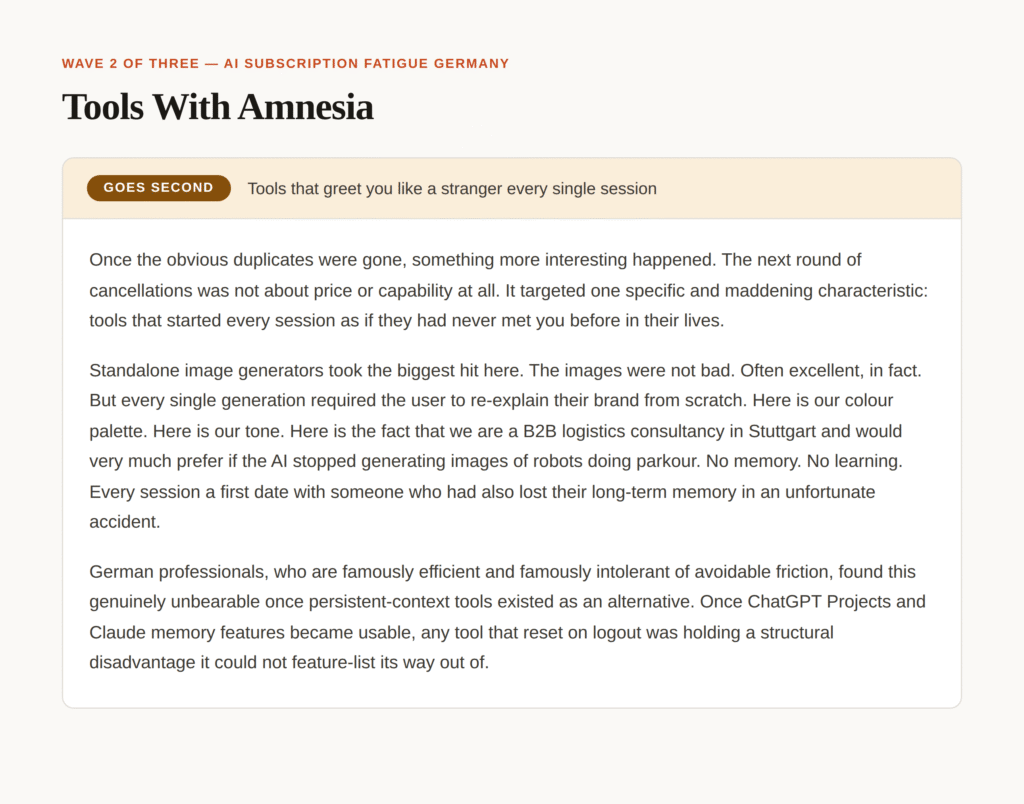
Tools With Amnesia
This is the most underreported part of the KI Tools kündigen Deutschland story. Context persistence did not show up on any feature comparison table as a deciding factor. It showed up in cancellation behaviour. The tools that knew you survived. The tools that forgot you, every single time, did not.
“I was copying and pasting a prompt document into every new session to remind the tool who I was. I had been doing this for four months before I realised this was objectively a ridiculous thing to be doing.” Marketing consultant, Dusseldorf
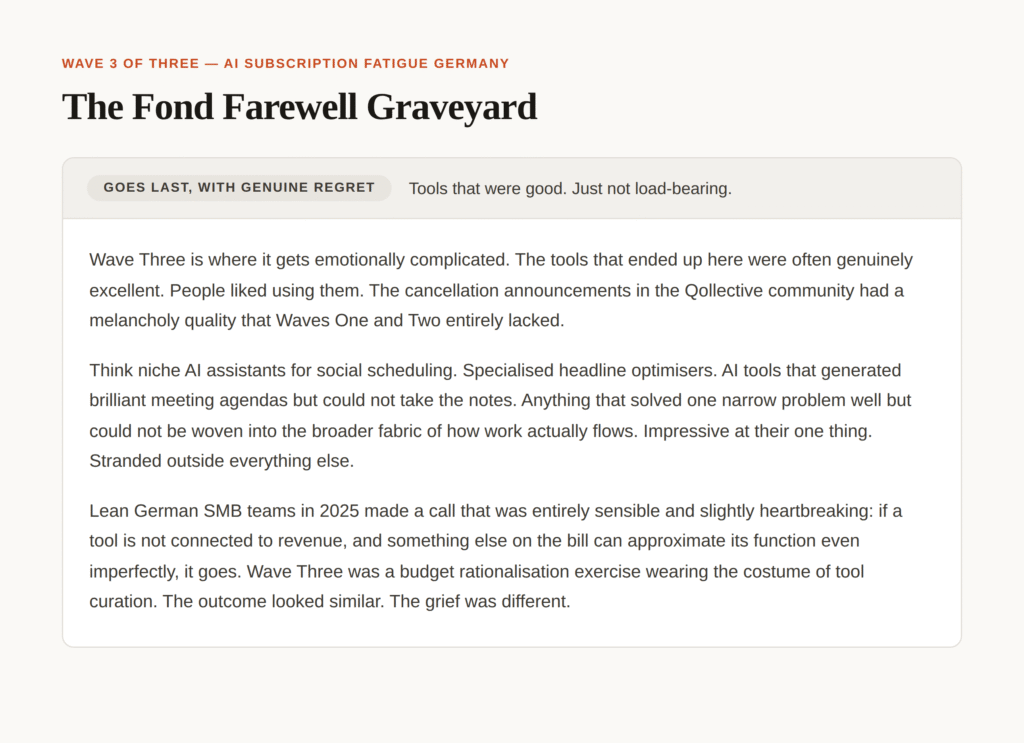
The Fond Farewell Graveyard
What survived Wave Three was not the smartest tools. Not the most impressive demos. The tools baked so deeply into an actual production process that removing them would break something real. When German businesses went looking for the best AI tools for German business 2025, the answer was not in the feature lists. It was in what they could no longer imagine working without.
What the Graveyard Actually Tells You
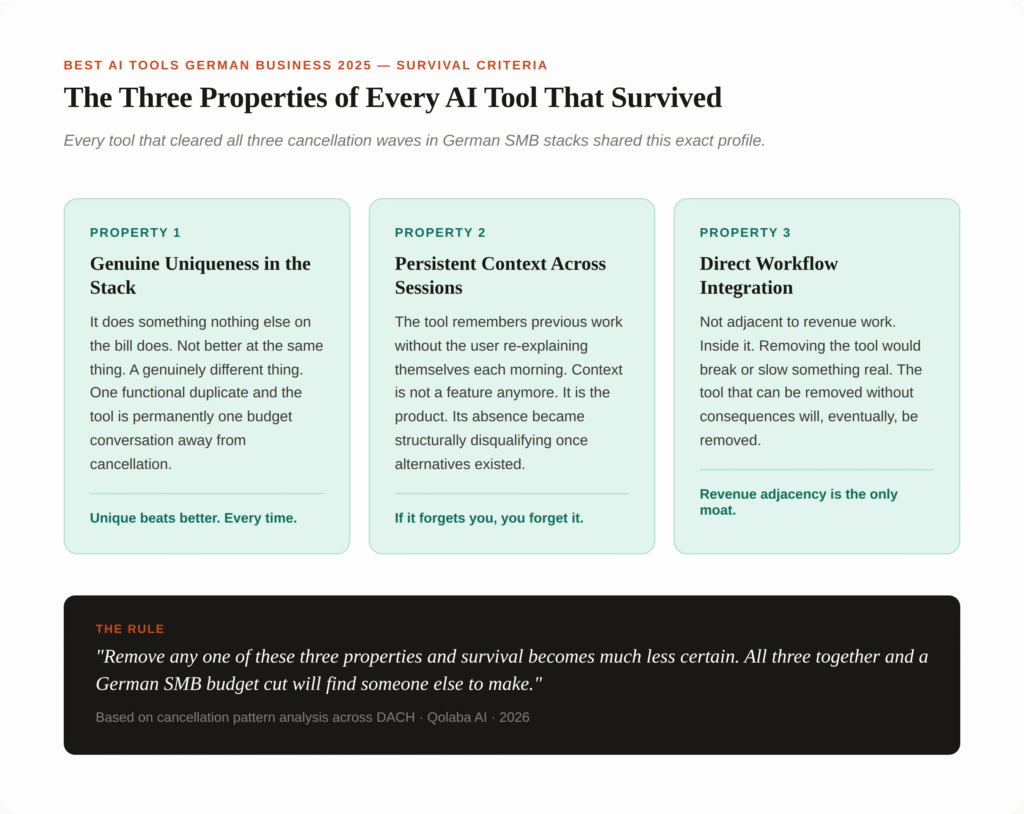
Put all three waves together and the picture becomes almost embarrassingly clear. German businesses value three things in an AI tool, in this exact order of priority, and the cancellation pattern is the proof.
This is not a hot take. It is arithmetic with receipts. When a team has five AI subscriptions and needs to cut two, the first two to go are the ones with the weakest case against those three criteria. Remove any one leg from the stool and survival becomes much less certain.
“The question ‘what are the best AI tools for German business?’ was not answered by feature comparison tables. It was answered by what people stopped cancelling. The tools that stayed passed all three tests.”
What This Means If You Are Building or Selling Into This Market
These three waves are your product requirements document, written in the subscription revenue of your competitors.
Uniqueness is non-negotiable. If your tool does something that three other things on the same bill also do, you are permanently one bad quarter away from cancellation. You can be measurably better and still lose. Better at the same thing does not survive Wave One. A different thing does.
Context persistence is now table stakes, not a differentiator. Any tool that resets on logout, re-asks for onboarding information each session, or cannot carry project knowledge across time is structurally disadvantaged in a way that output quality cannot compensate for. The market tried the alternative. The decision is in the data.
Workflow depth is the only genuine moat. Not product depth. Not model quality. The specific, boring, unsexy fact of being embedded in the step-by-step process of how a real team does real work. That is what survived all three waves.
The Graveyard Is Actually Good News
The dominant narrative around AI subscription fatigue in Germany has been framed as a warning sign. AI overpromised. Businesses are disillusioned. The bubble is deflating. This framing is wrong, and the cancellation data proves it wrong.
German businesses did not cut AI tools because they stopped believing in AI. They cut AI tools because the market matured. The early-adopter phase of collecting every interesting tool because you were afraid of missing something gave way to the far more grown-up phase of asking which tools are actually doing real work and cutting everything else.
That transition follows a logic. Redundancy goes first. Context poverty goes second. Workflow peripherality goes third. Every time. In every software category that has ever reached maturity. Understanding this logic means you can look at any company’s surviving AI stack and read it as a diagnostic of what they genuinely care about. You can predict what gets cancelled next. You can build tools that survive all three waves rather than being quietly sacrificed to the spreadsheet gods in Q3.
The German AI tool graveyard is not a failure story. It is a maturity story. The weak have been cleared. The bar is now visible. And it is entirely clearable, as long as you know which three things it is actually measuring.
Frequently Asked Questions
Why are German businesses cancelling AI tools in 2025?
Most cancellations follow a three-wave pattern: capability overlap tools go first (teams realising they are paying for Jasper and ChatGPT Plus simultaneously, which is one too many), context-free tools go second (standalone tools that reset every session and require the user to re-explain their brand from scratch), and workflow-peripheral tools go last (genuinely good tools that are not connected to anything that generates revenue). It is market maturity, not disillusionment with AI. The German market got more rigorous. It did not get less interested.
Which AI tools were cut most frequently by German SMBs?
Jasper AI, Copy.ai, Writesonic, standalone Midjourney, and Otter.ai appear most frequently in cancellation data across DACH. In nearly every case, the cancelled tool had a functional equivalent already in the stack that had become the primary daily habit. The tool that got cut was not necessarily worse. It was just not the one people had stopped thinking about opening.
What makes an AI tool survive budget cuts in Germany?
Three properties define the tools that survived all three cancellation waves in German SMB stacks: genuine capability uniqueness in the stack (it does something nothing else on the bill does), persistent context across sessions (the tool remembers previous work without the user pasting a prompt document in each morning), and direct integration in revenue-generating workflows (removing it would break or slow something real). Tools missing any one of these three are structurally vulnerable regardless of how good the output is.
Is AI subscription fatigue in Germany a sign that AI is failing businesses?
No, and it is worth being clear about this. AI subscription fatigue in Germany reflects market maturation, not disappointment. The early-adopter phase of signing up for every interesting tool in the category gave way to a consolidation phase where teams asked which tools are doing actual work and cut the rest. This is what software market maturity looks like. It happens to every category. The German market got more rigorous about AI tools, which is a different thing entirely from losing faith in them. If anything, a more rigorous market is better news for tools that have earned their place.
Try Qolaba Free — No Credit Card Required
400 credits on signup. Every AI model you need, in one workspace.