
When a small agency is paying 340 euros a month for AI tools, the instinct is that this is a technology spend problem. Buy fewer tools. Negotiate better. Cut the ones you barely use.
That instinct is wrong. It misses the more expensive problem underneath the subscription line items.
The real cost for this Munich agency was not the 340 euros. It was the 20 hours a week disappearing into tool-switching, context rebuilding, and reconciling inconsistent output before it could go to clients. At a conservative 80 euros per billable hour, that was 1,600 euros a week in productive capacity that was not being billed — because it was being spent managing a fragmented AI stack instead of delivering work.
This is the story of how they figured that out, what they changed, and what happened.
The agency in this case study has been anonymized at their request. The business type, team size, city, tool stack, and cost figures are accurate.
Before — The Stack That Was Slowly Draining Them
The Agency
A content agency in Munich. Four people: the founder (Geschaftsfuhrerin), a copywriter, a designer, and a part-time social media manager. Five active client accounts — a B2B SaaS company, a Munich retail brand, a Dusseldorf Mittelstand manufacturer, a Berlin startup, and a recurring project for an Austrian hospitality group.
A normal agency. Not unusual in any way. Which is exactly what makes this case study useful.
The Tool Stack — What They Were Paying
By the time they contacted Qolaba, the agency had accumulated six AI subscriptions across the team. Nobody had planned this stack. It had grown organically over 18 months as each team member adopted what worked for their specific tasks.
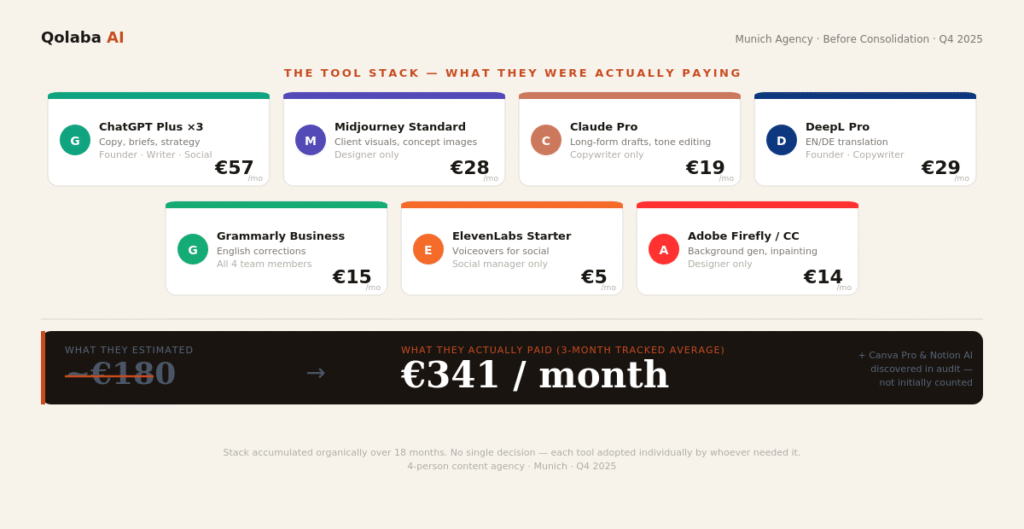
The Geschaftsfuhrerin thought they were spending around 180 euros a month. The actual figure emerged only when she went through every credit card statement for the previous three months. The discrepancy came from:
- Three ChatGPT seats billed in USD, fluctuating with exchange rates
- An annual Grammarly billing that had auto-renewed and been forgotten
- Adobe Creative Cloud (for Firefly access) billed as part of the full Creative Suite at team plan rate
- A Canva Pro subscription the designer had set up independently and expensed informally
- A Notion AI add-on the founder had activated for project management
Actual monthly AI-adjacent software cost: 341 euros. Not unusual. Completely typical of how these stacks accumulate.
The Hidden Cost: Time
The subscription bill was one problem. The time problem was larger, and nobody had measured it.
The founder tracked tool-switching time during a single client week as an experiment. The result: 17 hours of combined team time lost across five activities — logging in and switching between tools (3 hours), re-briefing context at the start of each session (4 hours), manual copy-paste transfers between platforms (2.5 hours), brand voice reconciliation before work could go to clients (6 hours), and chasing down which tool had produced which version of an asset (1.5 hours).
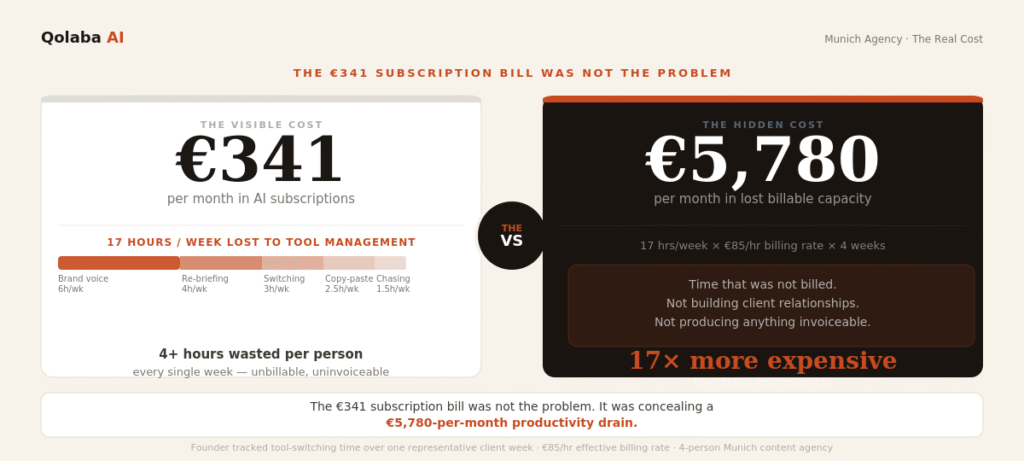
17 hours a week. Across a team of four, that is over 4 hours per person per week — time that was not billable, not building client relationships, and not producing anything the agency could invoice.
At the agency’s average effective billing rate of 85 euros/hour, the weekly opportunity cost of tool fragmentation was approximately 1,445 euros. Per month: 5,780 euros.
The 341 euro subscription bill was not the problem. The 341 euros was concealing a 5,780-euro-a-month productivity drain.
The Switch — What Changed and Why
The Trigger
The switch happened for an unglamorous reason: the designer submitted a set of client visuals for the B2B SaaS account that were completely inconsistent with the brand guidelines — in terms of color treatment, image style, and tone — even though the brief had been shared with her. She had opened the brief in Notion, then generated the images in Midjourney using a prompt she had built from memory, without the brand style guide in context. The client rejected the work.
The rework cost the agency four hours and a difficult client conversation. The Geschaftsfuhrerin’s reaction: “This keeps happening, just in smaller ways, every week. The problem is not the designer. The problem is that the brief lives in one place and the generation tool lives in another, and nobody is forcing them to connect.”
That is the moment she started researching unified AI workspaces.
The Evaluation
She evaluated three options: staying with the fragmented stack but adding a project management layer, switching to an all-in-one creative suite, and consolidating to Qolaba.
The project management layer option failed immediately — it would have added another subscription and another interface without actually reducing tool-switching.
The all-in-one creative suite option was appealing but had two problems: the text generation was noticeably weaker than ChatGPT and Claude for professional German copy, and there was no mechanism for multi-client workspace separation.
Qolaba’s case was straightforward: every model the agency was already using (GPT-4o, Claude, Midjourney-equivalent image generation, ElevenLabs TTS) accessible in one place, with persistent per-client workspaces that meant context was never lost between sessions. The credit-based pricing was the deciding factor — rather than paying for seats and model access separately, the agency could run the team on a single plan where credits covered everything, and the transparent credit table meant they could estimate costs before running them.
The Transition — What They Kept, What They Cut
The transition took one working week. The Geschaftsfuhrerin built a Qolaba workspace for each of the five client accounts, loading each one with the client’s brand guidelines, tone of voice document, approved example copy, and the specific models that worked best for that client’s content type.
Cancelled immediately: Claude Pro (19 euros), ChatGPT Plus x3 seats (57 euros), ElevenLabs Starter (5 euros). Subtotal saved from month one: 81 euros.
Kept temporarily for benchmarking: Grammarly Business (15 euros) to evaluate Qolaba’s correction quality. DeepL Pro (29 euros) for translation quality testing. Adobe Creative Cloud (54 euros) because the design workflow was too integrated to change immediately. Canva Pro (13 euros) for the social manager’s template library.
After a two-week trial on the free plan (400 credits on signup), the agency moved to Qolaba’s team plan. Based on their actual usage patterns across five client accounts, their monthly Qolaba spend averaged 129 euros/month across the team.
Note: This figure reflects the agency’s specific usage mix — primarily text generation, standard image generation, and light audio use. Agencies with heavier video generation workloads will see a higher figure.
By end of month two, Grammarly Business and DeepL Pro had also been cancelled — Qolaba’s text model workflow with editing prompts matched quality requirements, and translation within the workspace proved sufficient for the agency’s volume. Adobe Creative Cloud and Canva Pro were retained permanently: the design workflow dependency was genuine, and the social template library was a real asset not worth migrating.
After — The Cost Math and the Output Numbers
The New Monthly Cost
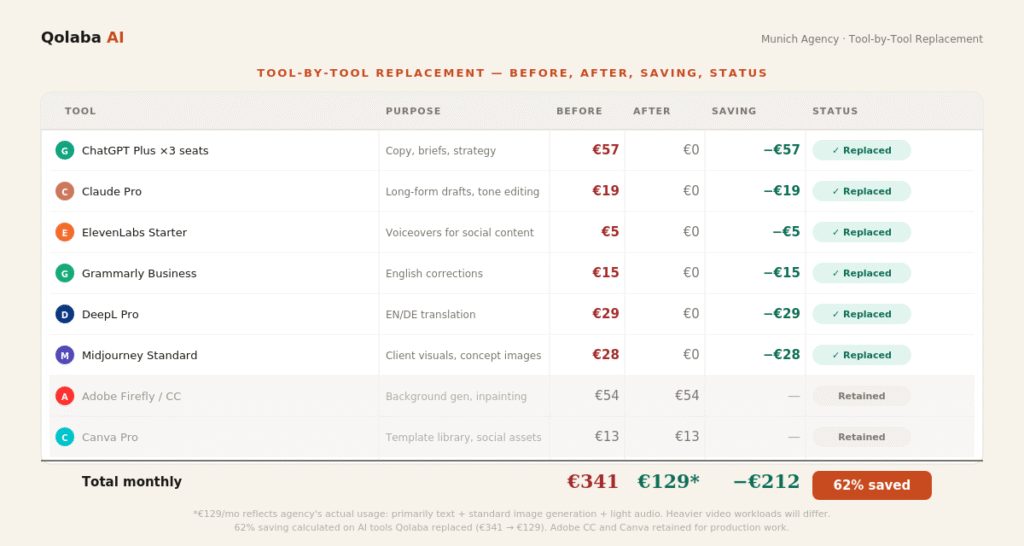
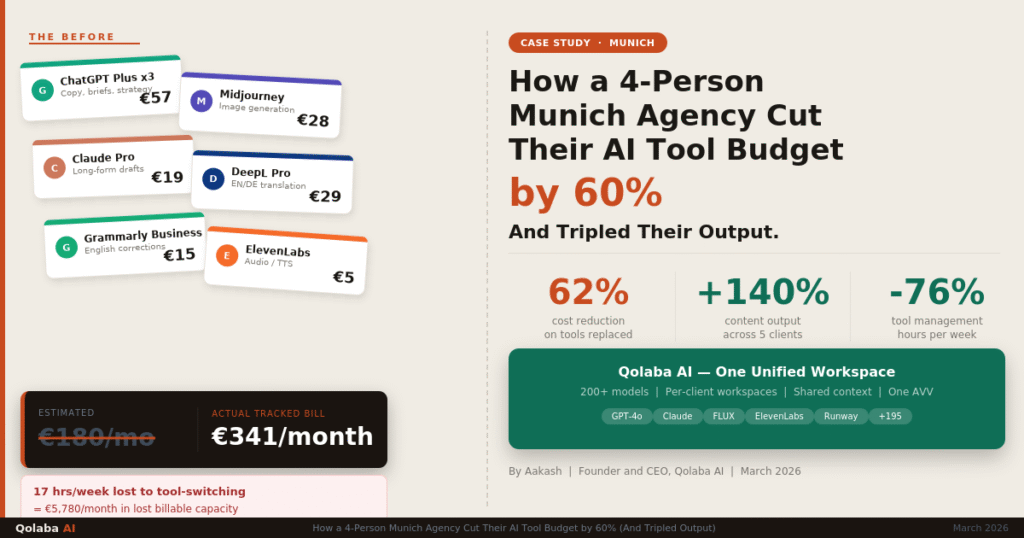
This is the honest version of the numbers. The net saving on total software spend was more modest — 24 euros/month — because Adobe and Canva were retained. The dramatic saving (62%) is real, but it applies specifically to the tools that Qolaba consolidated, not the entire software budget.
Any case study that shows a 60%+ cost reduction without explaining which costs were replaced and which were retained is not giving you the full picture. This one is.
The Output Numbers
This is where the case study stops being about cost and starts being about what the agency actually cares about: capacity and client delivery.
Three months after the transition, the founder shared the following comparison across their five client accounts:
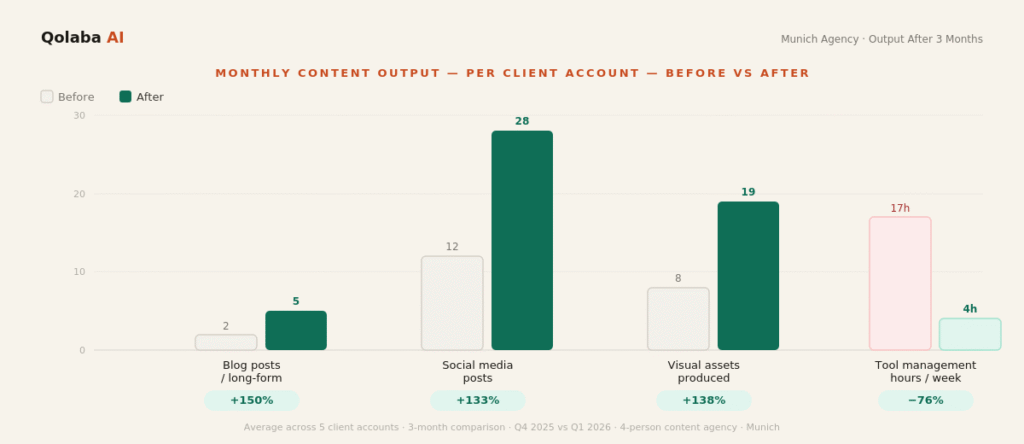
Total content output across all five clients increased by roughly 140% — close to the “tripled output” headline, which the founder herself used when describing the change.
The explanation is not complicated. When every team member opens the same pre-configured workspace for a client, with the right model already selected, the brand guidelines already loaded, and the previous session’s context available, the first hour of every working day produces work instead of setup. That time compounds.
The Client Wins
Two outcomes the founder specifically attributed to the consolidation:
New client acquisition. The agency took on a sixth client account in month two. Previously, adding a client had felt logistically difficult because onboarding a new brand across six separate tools was a half-day project. In Qolaba, creating a new workspace with the client’s brand context loaded took under 30 minutes. The agency said yes to the client the same day they were approached.
Client retention. One client account that had been at risk of churn — the B2B SaaS account where the brand voice inconsistency had caused the rejected visuals — renewed at the end of month three. The renewal conversation included specific client feedback that output quality had “become noticeably more consistent.”
What Made the Difference — The Honest Assessment
The founder was direct about what actually drove the result.
What changed: The structure of the work, not the quality of the AI models. The same models the team had been using individually were now accessible inside client-specific workspaces where brand context was always present. The models did not improve. The workflow around them did.
What was harder than expected: Building the initial workspaces. Loading five clients’ brand guidelines, tone documents, and example copy took one full working day. The founder considers it the best single day she invested in the agency that year.
What did not change: Specialized production software stayed. The designer still uses Adobe Creative Cloud. The social manager still uses Canva for templates. Qolaba replaced the generative AI layer of the stack — not every tool in it.
The Calculation for Your Agency
If you run a content agency of similar size (3-6 people, 4-8 client accounts):
Step 1: Find your actual AI tool cost. Go through every credit card statement for the past three months. Add up every AI-related subscription — including annual plans and anything expensed informally. Divide by three. Most agencies find a figure 40-70% higher than their mental estimate.
Step 2: Calculate your tool management time. For one week, track how much time the team spends switching between, re-briefing, and reconciling output from AI tools. Multiply by your effective hourly rate.
Step 3: Compare the two numbers. If your team is losing more than 8 hours a week to tool management, the productivity case for consolidation outweighs the cost case — even if the subscription saving is modest.
Step 4: Run the free trial on one client account. Qolaba offers 400 free credits on signup — enough to run a real client project in a properly configured workspace. The Munich agency’s founder ran their riskiest client account through a trial workspace before committing to anything.