

Which AI Model Is Actually Right for You? 2026 Honest Comparison
Let’s start with the uncomfortable truth: if you’ve been searching for the “best AI tool for business” hoping for a definitive answer, you’ve probably noticed that every article disagrees with the last one. That’s not because the internet is broken (well, not entirely). It is because the question is.
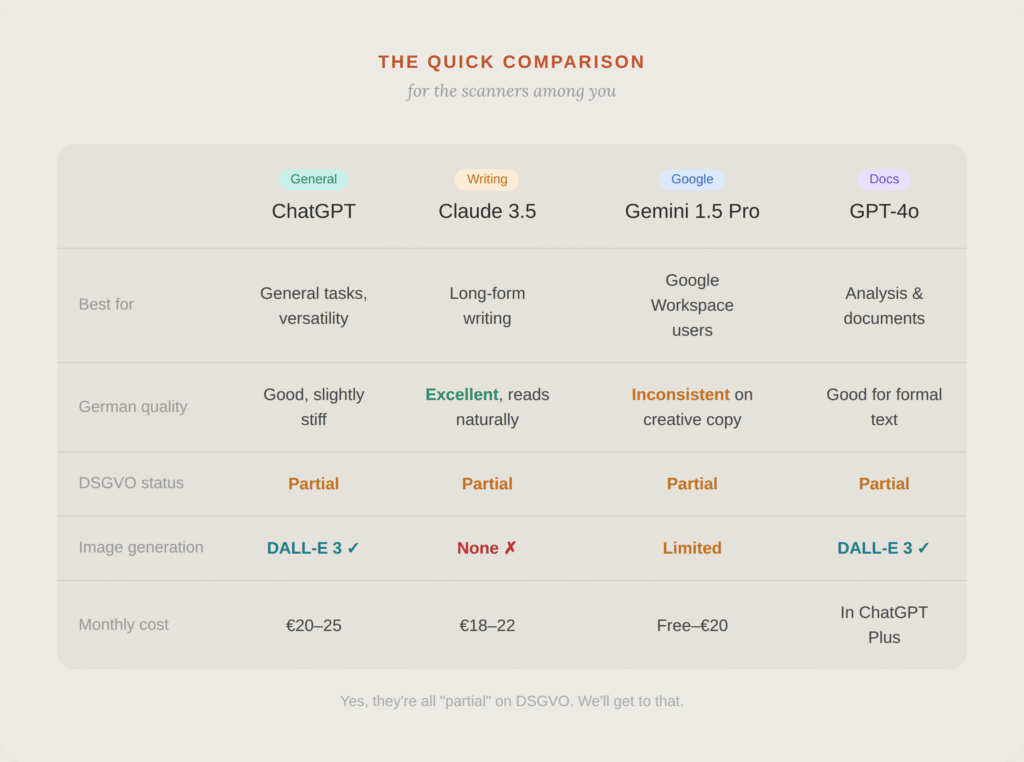
There is no single best AI model. There’s the best model for your specific task, and those are quite different things. After looking at how German businesses are actually using these tools in 2026, a clear pattern emerges: the teams getting the most value aren’t the ones who picked one model and stayed loyal. They’re the ones who figured out which tool to reach for and stopped feeling guilty about using more than one.
ChatGPT: The Reliable Generalist
If AI tools were office colleagues, ChatGPT would be the one who can turn their hand to almost anything. Not always the most elegant person in the room, but always shows up, always delivers something usable, and generally the first one you’d call if something needed doing before tomorrow morning.
ChatGPT handles variety better than any other model here. Drafting emails, writing code, summarising a 40-page report, building a formula in Excel, answering a surprisingly specific research question on a Sunday evening, it manages all of it at a consistently solid level. It can also read images and documents, meaning you can hand it a photo of a whiteboard or a scanned contract and ask it to make sense of what it sees. For businesses still dealing with paper-heavy processes, that turns out to be considerably more useful than it sounds.
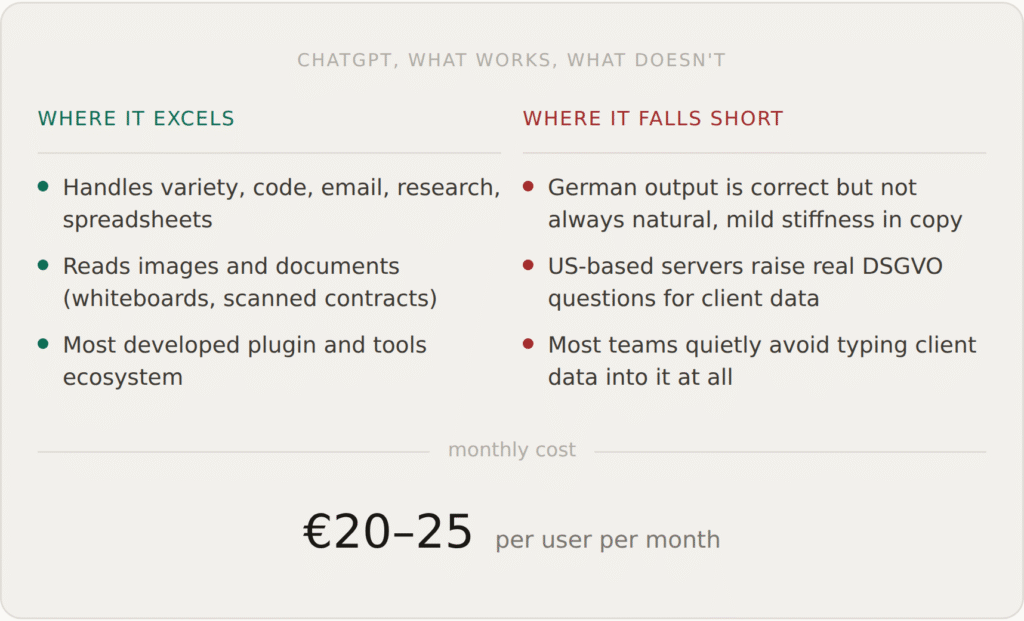
For internal documents and quick drafts, ChatGPT is perfectly fine. For anything a client is going to read carefully, it often needs a human edit before it goes out.
Claude 3.5: The Writer’s Model
If ChatGPT is the colleague who does everything adequately, Claude is the one you ask to write the important email. The one going to a difficult client, or the proposal that actually needs to win. You would not ask them to fix the printer, but that is not why you hired them.
Claude’s German is noticeably more natural than ChatGPT’s. Less stiffness, fewer oddly-translated phrases, and a much better feel for tone across different situations, from formal business correspondence to editorial content to the kind of careful client communication where getting the register slightly wrong is genuinely costly. If you have ever quietly rewritten an entire AI-generated paragraph before sending it, you will notice the difference with Claude fairly quickly.
Claude also has a very large working memory within a single conversation: load a full client brief, brand guidelines, and previous work all at once and the output will reflect all of it. For consultants managing multiple clients, accidentally blending tones is a real hazard. Claude makes it much less of one. Use persistent project workspaces to keep each client’s context cleanly separated.
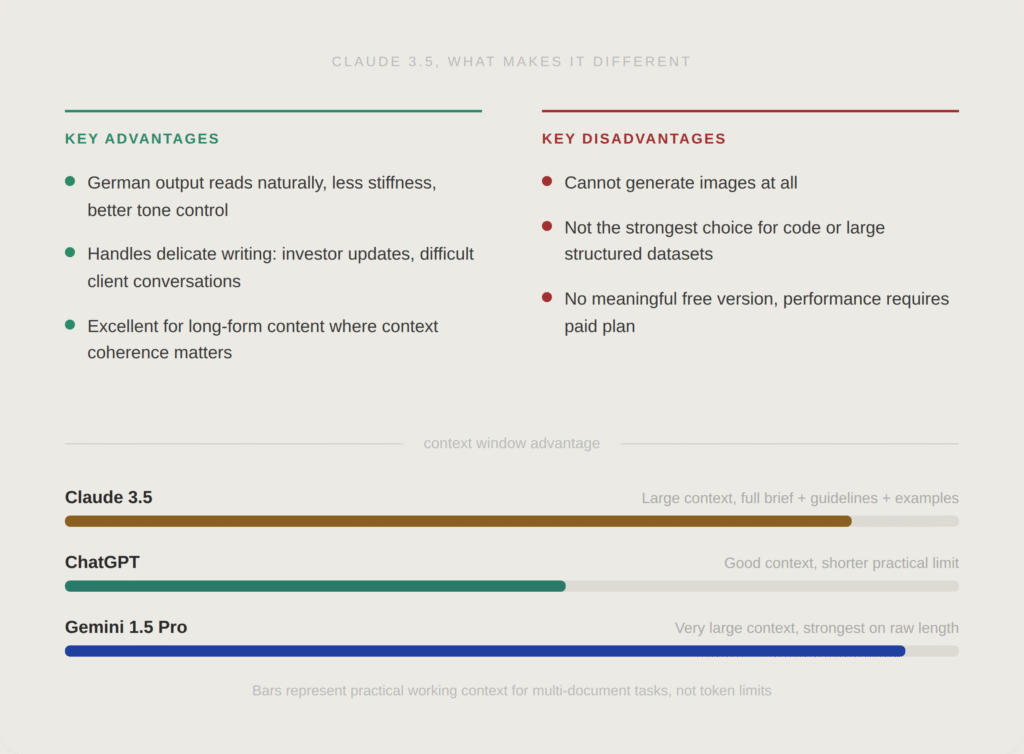
Investor updates. Difficult client conversations. Announcements that need to land exactly right. These are the moments where Claude’s difference becomes obvious.
Gemini 1.5 Pro: The Google Native
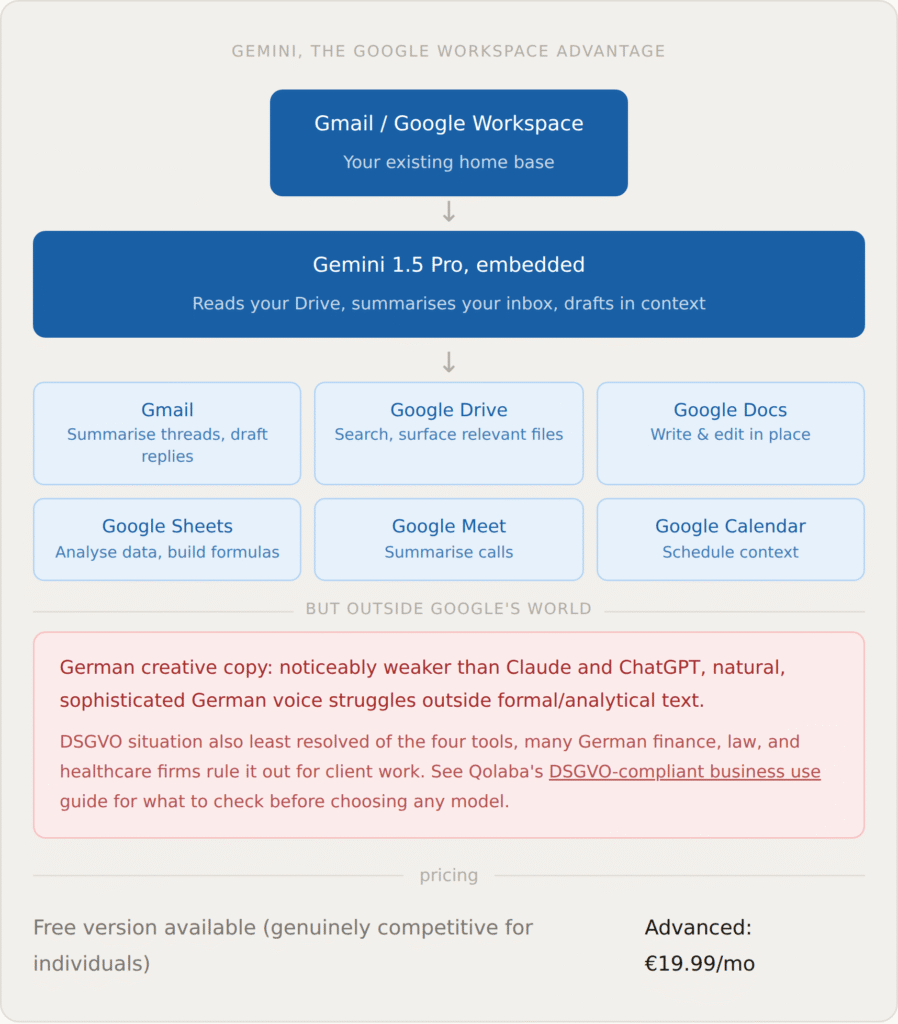
If Gemini were an office colleague, they would be the one who only really functions inside the company system. Put them in front of your internal tools and they are genuinely impressive. Ask them to work somewhere unfamiliar and things get a bit slower and less precise. Not a criticism, just a fair description of how the tool was designed.
The connection to Google’s products is Gemini’s real differentiator. You can ask it to summarise the last month of emails on a specific project, pull relevant files from Google Drive, and draft a response, all without leaving Gmail. For teams that already live inside Google’s world, that kind of integration saves real time and removes a meaningful amount of daily friction.
GPT-4o for Document Analysis: Worth a Specific Mention
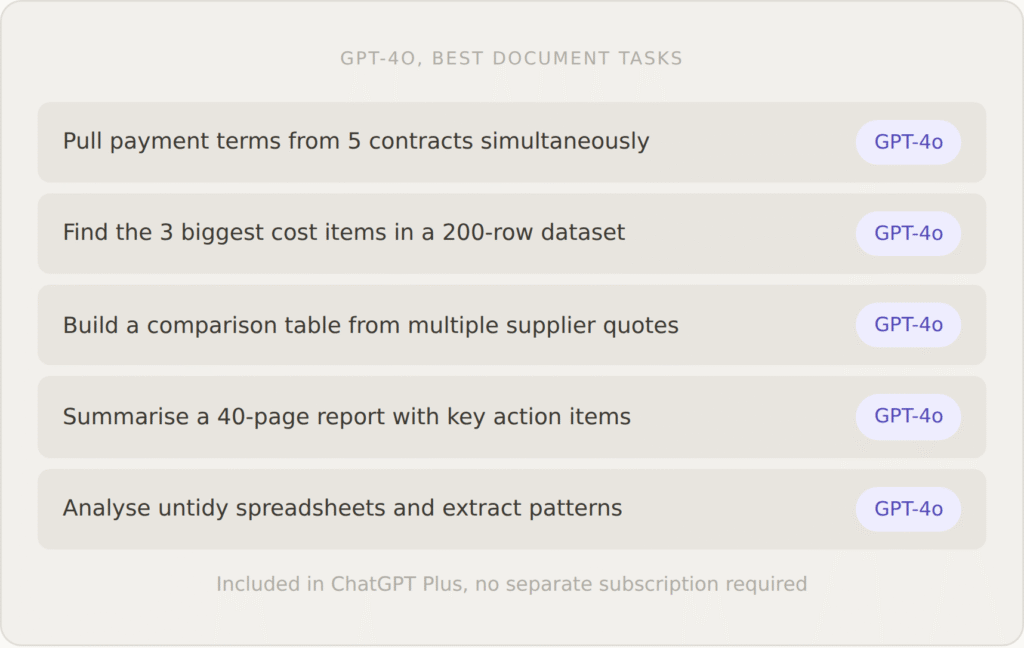
If the other models are the people who write things, GPT-4o is the one who actually reads the stack of documents that has been sitting on your desk since January. Quietly, thoroughly, and without complaint.
GPT-4o comes included in ChatGPT Plus, which makes it easy to overlook. Give it a structured task: pulling payment terms from five contracts, finding the biggest cost items in a dataset, building a comparison table from supplier quotes, and it outperforms the other models here. Work that would take a person most of a morning, GPT-4o completes before your coffee gets cold.
So, Which One Is It?
Picking one and declaring it the winner isn’t the rational move. Use Claude when writing quality matters, ChatGPT for general tasks, GPT-4o when buried in documents, Gemini when the whole workflow runs through Google. With team collaboration and transparent credit pricing, Qolaba lets you access all of them without juggling separate subscriptions.
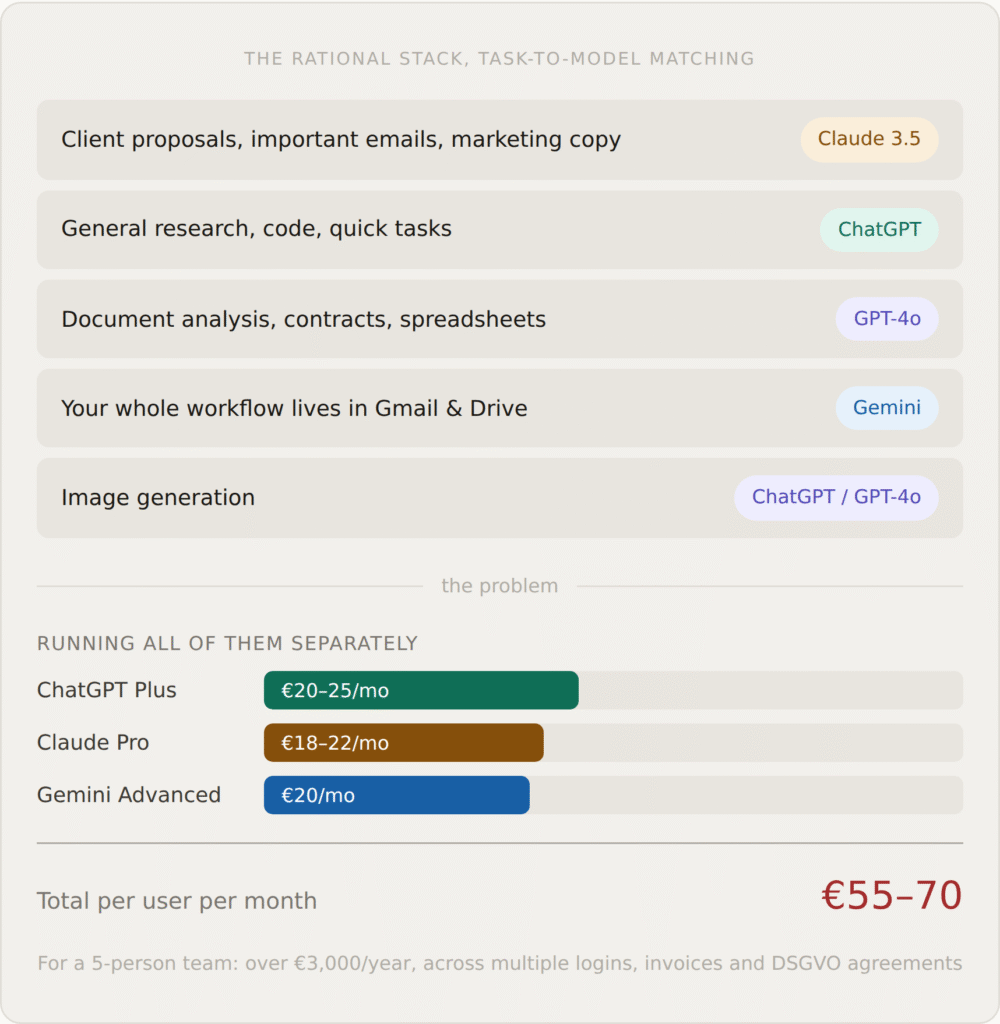
Running all of that properly costs between €55 and €70 per user per month. For a five-person team, that is over €3,000 a year, spread across multiple logins, billing accounts, and if you are doing this correctly under DSGVO, multiple separate data processing agreements that somebody in your company actually has to read and sign off on. Tools like Qolaba give you access to 60+ AI models under one subscription, with a single login, one invoice, and one platform to manage for compliance purposes. Increasingly, the answer to “do I need to pay for all of these separately” is no.
The real question is not which model is best. It is whether you need to pay for all of them separately in order to use all of them.
Frequently Asked Questions
Which AI model is best for German business writing?
Claude 3.5 produces the most natural German, less stiffness, better tone control across formal and informal registers. For client-facing correspondence, proposals, and marketing copy, it consistently outperforms ChatGPT and Gemini on language quality.
Is ChatGPT DSGVO compliant for German businesses?
Enterprise tiers offer data processing agreements (AVV). Consumer accounts do not. Employees using a personal ChatGPT account for work involving customer data are likely not covered by a valid AVV, potential liability under DSGVO Article 83 includes fines up to €20 million or 4% of global turnover.
Is Gemini worth it for Google Workspace users?
Yes, if you live in Gmail, Drive, and Docs, the native integration genuinely saves time. But German creative copy is its weak spot, and its DSGVO situation is the least resolved of the four. Most German teams use Gemini for internal tasks and something else for client-facing content.
Do I need to subscribe to all these AI tools separately?
No. Tools like Qolaba give access to 60+ AI models, including ChatGPT, Claude, and Gemini, under one subscription, one login, one invoice, and one DSGVO agreement. A typical separate stack costs €55–70 per user per month; Qolaba consolidates that significantly.