
An honest look at what you are actually paying for, and whether consolidation changes anything that matters
There is a particular kind of subscription fatigue that only happens in offices. It is not the fatigue of paying for things you don’t use. It is the fatigue of paying for things you use constantly, just not efficiently, because each one is a separate login, a separate chat history, a separate invoice, and, if your legal team has ever asked a pointed question about it, a separate document you should probably have signed before you started passing client data through it.
That is where most German teams find themselves with AI in 2026. Not avoiding it. Not misusing it. Just running it in the most expensive, most fragmented, and most compliance-risky way available, because nobody sat down and looked at the stack as a whole. This article does that.
It also makes a case for a category worth understanding before the decision gets made by default: the unified AI workspace. What it actually is, when it genuinely makes sense, and what to look for if you decide the fragmented stack is costing you more than it should. Which it probably is. But we’ll come to that.
Either way, someone in your office has turned their AI productivity tools into a part-time job managing their AI productivity tools. Four tabs. Four logins. Four separate contexts to rebuild from scratch each morning. They would like their Tuesday afternoons back. This is a reasonable thing to want.
What Is an AI Workspace, Exactly?
If standalone AI tools are the specialists, one for writing, one for images, one for code, a unified AI workspace (what the tools industry has settled on calling an AI aggregator, though the name makes it sound like something running in a server room rather than saving you forty minutes on a Tuesday) is the building they all work in. The building where each room remembers what happened in it, where the same key opens every door, and where the invoice arrives once a month from one address rather than four addresses that you keep meaning to consolidate but somehow never do.
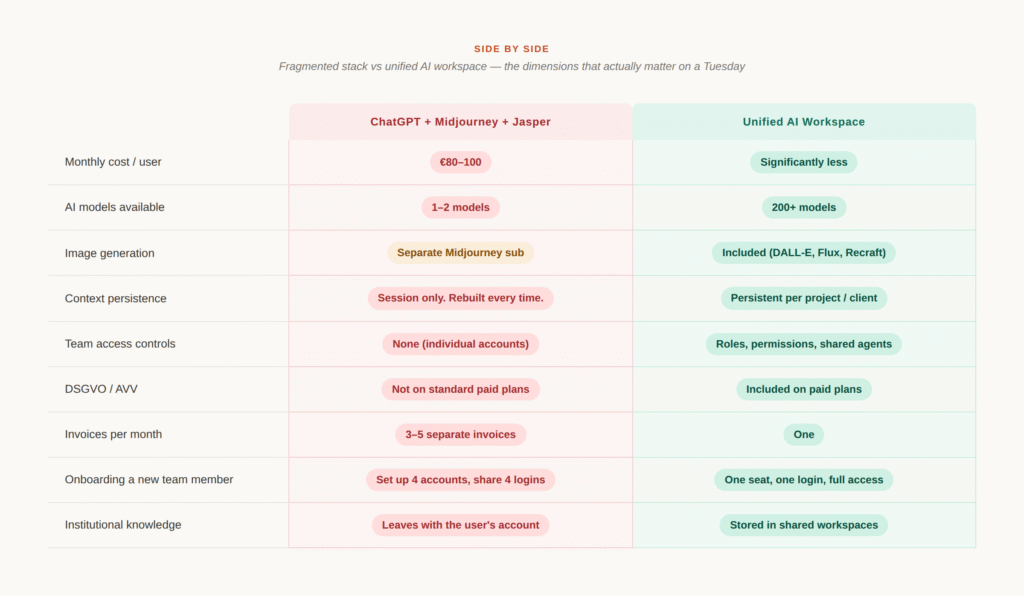
The distinction matters because the AI tool market has spent three years making this confusing. Every tool calls itself a platform. Every chatbot claims to do everything. The AI platforms for business category has developed the same enthusiasm for horizontal vagueness as the CRM market did in 2015. The differences between AI models that actually affect your working week are rarely the ones getting covered in the press. The practical difference between a standalone tool and a workspace comes down to four things, and when you see them side by side, it becomes fairly obvious which end of the table you are currently sitting at.
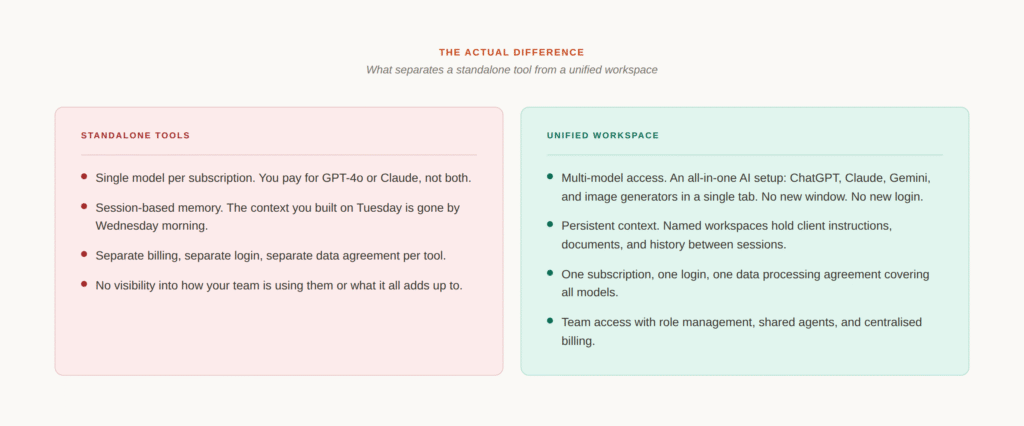
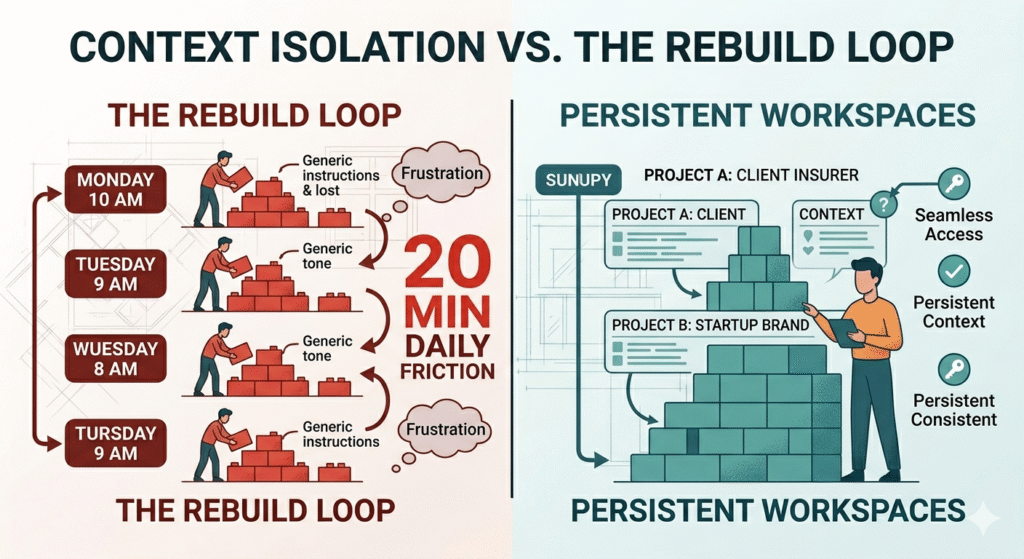
The context persistence point is the one that tends to land hardest when people actually experience it. Rebuilding your instructions every session, the client’s tone, their forbidden phrases, the fact that they hate bullet points and always want formal Sie, is work that happens invisibly. You don’t notice how much time it takes until you stop doing it. It is a bit like discovering you’ve been opening a door with your elbow for six months because you assumed the handle was broken, and then someone points at the handle.
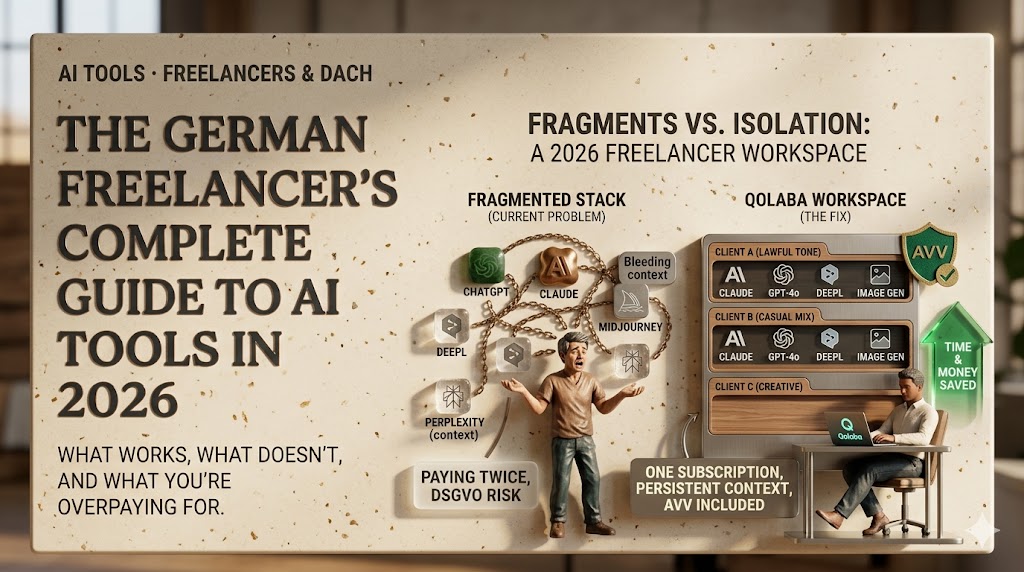
The Fragmented Stack Problem: Total Cost, Total Friction
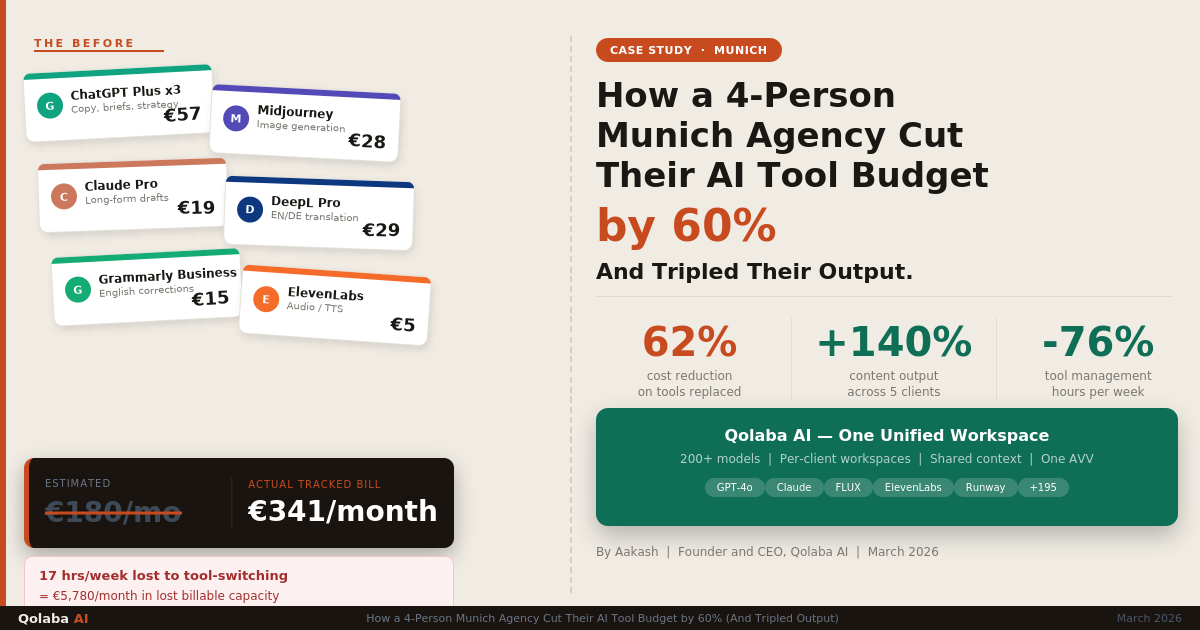
The average German business team using AI seriously in 2026 is running something that looks like this: ChatGPT Plus for general tasks and document analysis, Claude Pro for anything that needs to be written well, Midjourney for visuals, and Jasper or a similar content tool for the marketing team. Each chosen for a perfectly good reason. None of them chosen with any view of what the whole stack adds up to. A side-by-side AI subscription comparison tends to make this visible quite quickly.
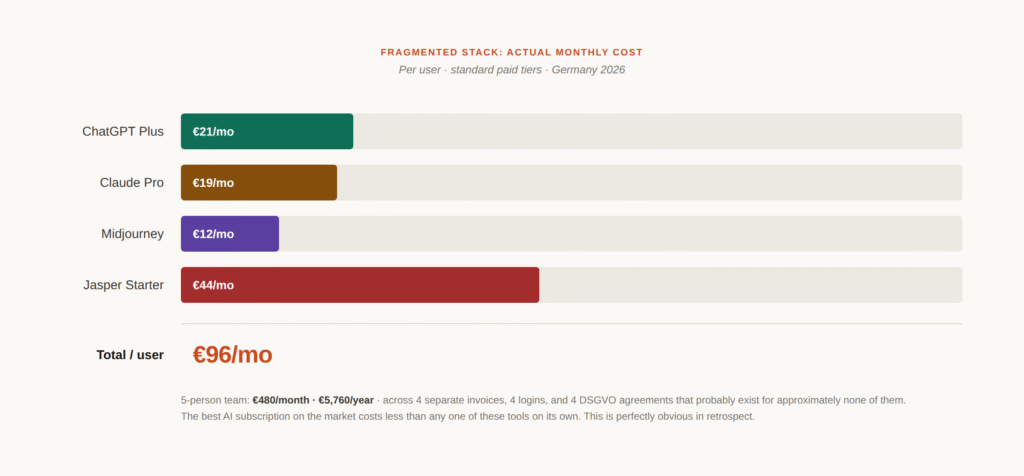
The money is the obvious part. The less obvious part is the friction: four separate browser tabs, which is what using multiple chat AIs at once actually looks like in practice, four different chat histories with no connection between them, no way to see what the rest of your team is doing, no shared context, and no single person who actually owns the relationship with any of these providers. When someone leaves the company, their ChatGPT history leaves with them. Nobody knows what Jasper workflows the marketing team spent three weeks configuring. The institutional knowledge lives inside tools that were never designed to hold it, in accounts that belong to individuals rather than to the company. This is fine right up until it very suddenly isn’t.
And then there is the compliance piece, which is where the discomfort tends to become acute. Four separate tools means four separate data processing agreements, the Auftragsverarbeitungsverträge (AVVs) that DSGVO requires any time you process personal data through a third-party processor. ChatGPT Plus does not include an AVV. Claude Pro does not include an AVV. Midjourney does not offer one clearly at all. For a team doing any client work involving names, contacts, or business data, that is an exposure that tends to surface only when someone asks a pointed question about it. Usually a client. Usually at an inconvenient time.
The fragmented stack problem is not that the tools are bad. It is that nobody designed the stack. It just accumulated.
Side by Side: Fragmented Stack vs Unified Workspace
Setting the two approaches against each other across the dimensions that actually matter for a German business team. When people compare AI tools in practice rather than in theory, the instinct is to reach for benchmark scores and feature checklists. Most AI comparison tools online do exactly that. This table measures Tuesday instead.
When a Unified Workspace Makes Sense (and When It Doesn’t
There is a version of this article that makes consolidated workspaces sound like the obvious choice for literally every person who has ever typed a prompt into anything. That version would be neither accurate nor honest. There are situations where staying with individual tools is the rational decision, and it is worth being specific about where the line actually falls.
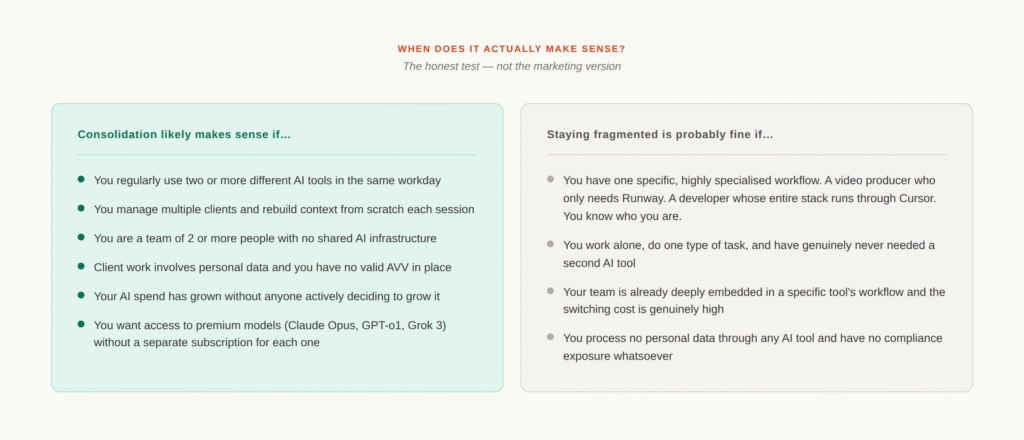
The honest test is this: on a normal working day, how many AI tool windows are open at once? If the answer is one, you probably don’t need a workspace. If the answer is three, the fragmented stack is costing you something, in money, in time, or in the quiet discomfort of knowing your DSGVO situation is less resolved than it should be. If the answer is five, you have already identified the problem. You are just still paying for it. German teams who have made the switch tend to describe the same realisation: they did not notice how much of their Tuesday afternoons the fragmented stack was quietly eating until they got them back. If you are looking for what the best AI for business looks like for a team of two to twenty, the answer tends to start exactly here. The same applies to AI tools for small businesses that have simply outgrown individual accounts without anyone formally deciding to do anything about it. That last category is larger than most people admit out loud.
What to Look for in an AI Workspace for German Businesses
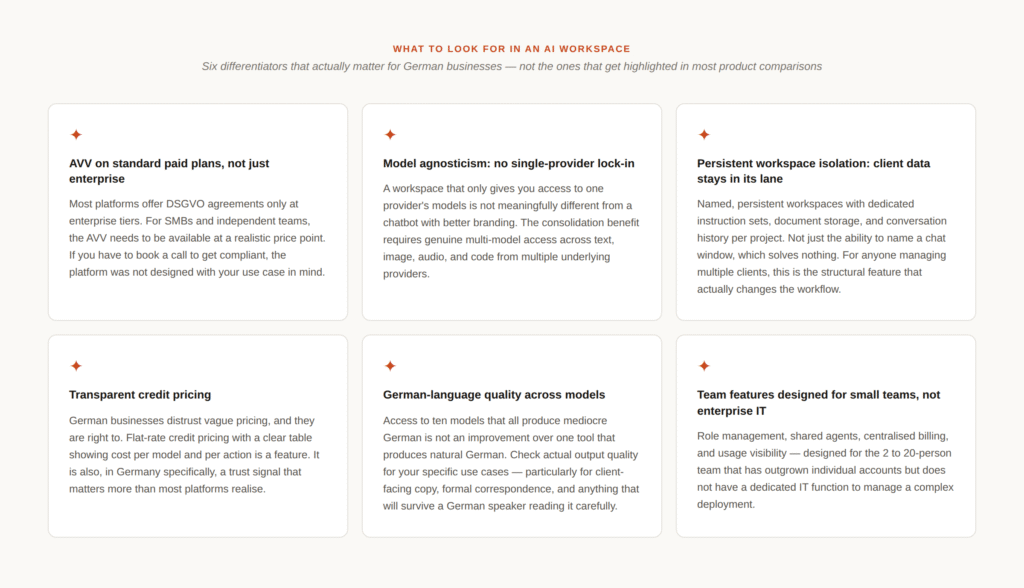
Not all unified workspaces are equal. The best AI tools for business in Germany have a specific set of requirements that most platforms designed for the American enterprise market have not prioritised. The market is noisy and the marketing is, to put it charitably, enthusiastic. Here is what actually separates a serious platform from one that has simply rebranded a chatbot and added the word “workspace” to the homepage.
Three German Teams Who Made the Switch
Abstract comparisons only go so far. Here are three real situations, condensed with permission, showing what the transition from a fragmented stack actually looked like in practice. Not the idealised version. What happened on the ground, including the parts that took longer than expected.
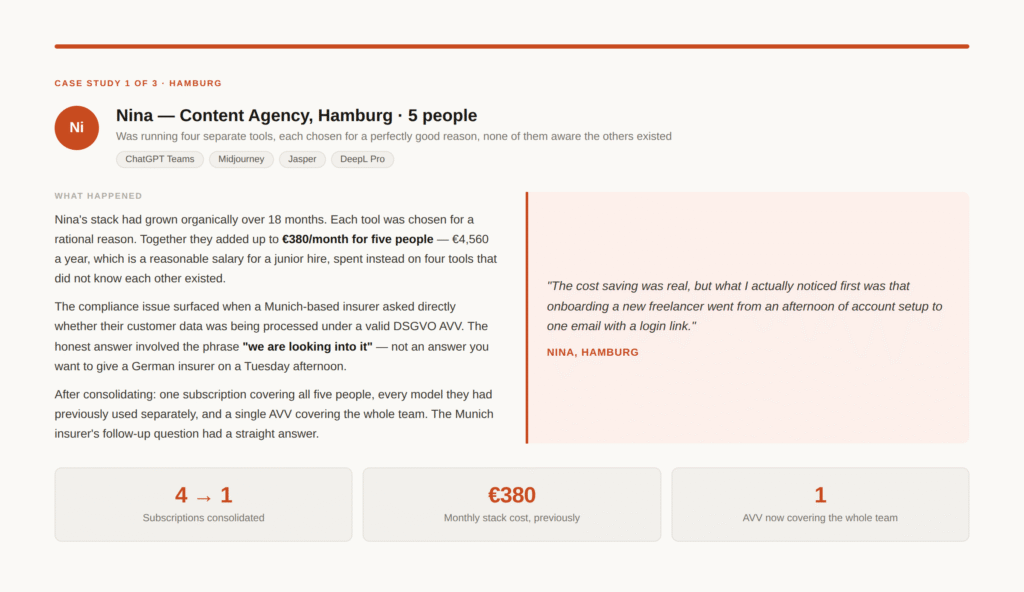
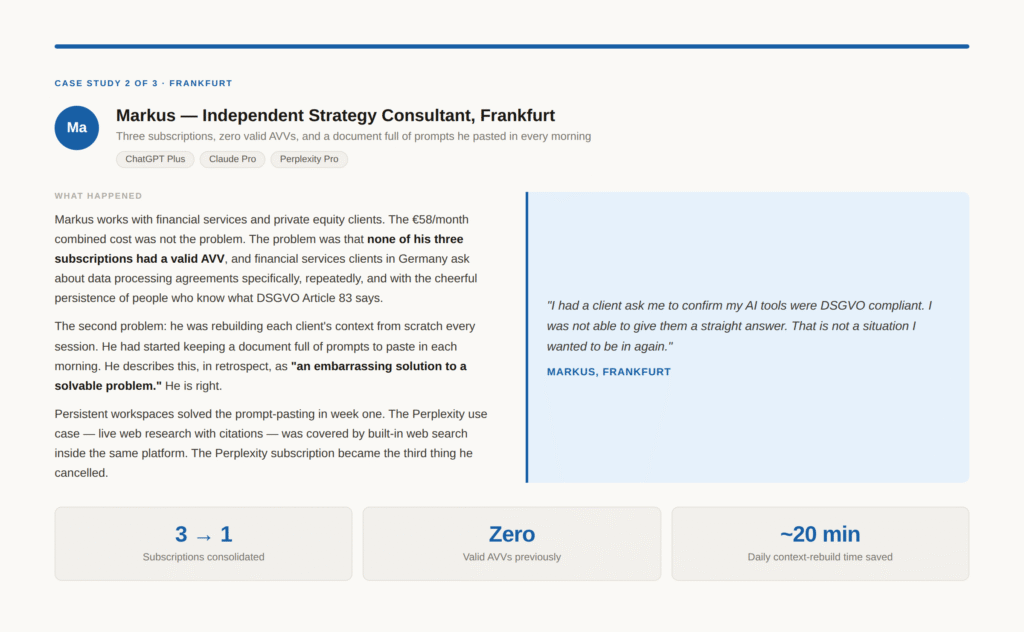
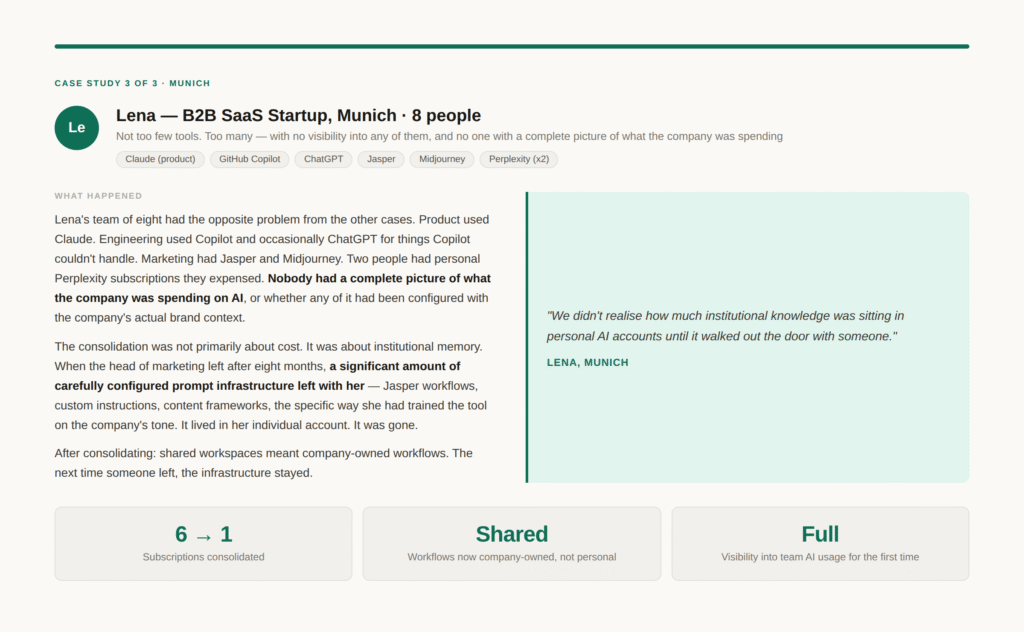
Three different situations. Three different primary reasons for consolidating: compliance, context persistence, institutional memory. The cost saving was real in all three cases. It was not, notably, the thing any of them mentioned first when asked what changed.
ChatGPT is a single-model tool with session-based memory and no multi-model access. An AI workspace is a unified environment giving you access to multiple models, ChatGPT, Claude, Gemini, image generators, under one subscription, with persistent context per project and team access controls. The key difference is not the AI. It is the infrastructure around it.
Yes, for most use cases. Platforms like Qolaba give access to 200+ AI models including ChatGPT, Claude, Gemini, DALL-E, Flux, and others under one subscription. A fragmented stack of ChatGPT Plus, Claude Pro, and Midjourney Basic costs €50–60 per user per month. A unified workspace typically reduces that significantly, with better context management and a single DSGVO data processing agreement that actually covers you.
DSGVO compliance depends on whether the platform offers a valid Auftragsverarbeitungsvertrag (AVV) on standard paid plans, not just enterprise tiers. Consumer accounts for ChatGPT Plus and Claude Pro do not include an AVV. Check this explicitly before choosing a platform, and verify that the AVV is available at your actual plan level, not just somewhere in a pricing table you would have to scroll quite far to find.
If you have one specific, highly specialised AI workflow, a video editor who only needs Runway, a developer whose entire stack runs through Cursor, a unified workspace will not improve your situation meaningfully. The consolidation benefit is greatest for people who regularly switch between two or more different AI capabilities within the same workday. One clear use case equals one focused tool. There is no shame in it.
Try Qolaba Free — No Credit Card Required
250 credits on signup. Every AI model you need, in one workspace.
Start free at qolaba.ai285,000+ users · 60+ countries · DSGVO-compliant