

Spoiler: it’s more than you think, and at least one of those tools you forgot you signed up for.
Let’s begin with an experiment. Open your bank statement and search for the word “AI.” Then search for “GPT.” Then “Midjourney.” Then “Notion” (which quietly added AI last year). Then “Adobe” (same). Then “Canva Pro” (also AI now). Then “Grammarly.” Then maybe sit down.
If you got through that list without mild anxiety, you are either extremely organised or you bank with your eyes closed. Most German founders we speak to land somewhere in the middle: they know they’re subscribed to several things, they roughly know the monthly number, and they have a hazy sense that some of it is probably redundant. Like a gym membership, but the guilt hits monthly instead of quarterly.
Today we’re doing the maths. Then we’re giving you a framework to actually do something about it, instead of closing this tab and meaning to deal with it later.
The Hidden Cost of AI Tool Redundancy
Here is something the AI tool industry does not particularly want you to think about: most AI tools are doing roughly the same thing. ChatGPT Plus and Claude Pro are both large language models. They write, they summarise, they analyse, they code. Gemini Advanced does the same. You do not need all three unless you are a researcher actively comparing model outputs.
The average German SMB running a five-to-six tool AI stack is paying for at minimum two tools that handle text generation, one tool that generates images (often already bundled into a second text tool they never noticed), and one “productivity AI” that is, if we are being honest, just GPT-4 wearing a different hat and charging extra for the hat.
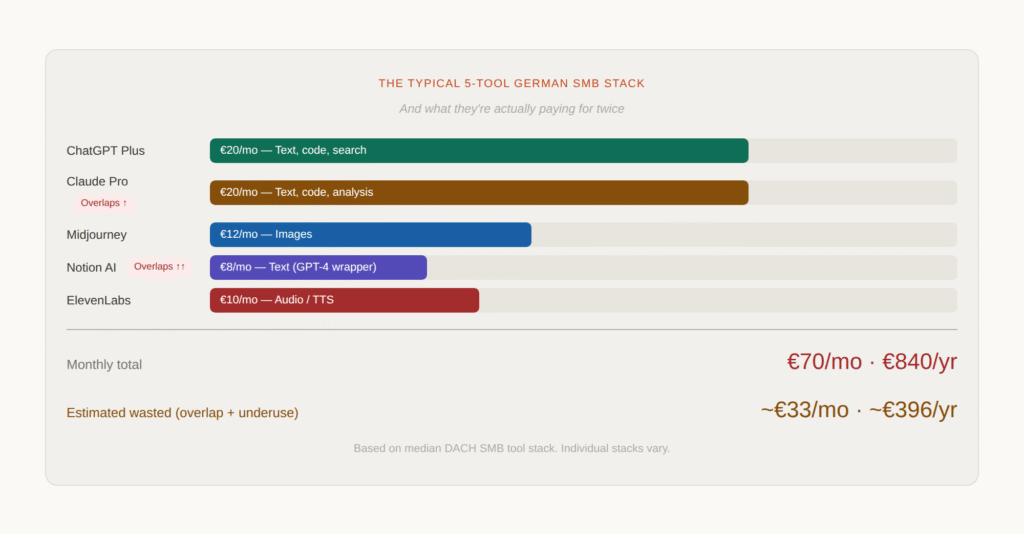
The rough rule: if two tools in your stack both offer text generation as their primary feature, you are almost certainly paying for the same capability twice. The features that actually differ between models (writing style, context window, image generation, coding accuracy) rarely justify maintaining dual subscriptions unless you’re using both every single day. And if you are, we respect the dedication.
The “Just in Case” Subscription Trap: Where €936/Year Actually Goes
There is a very specific psychological pattern behind most AI tool waste. It goes like this: you sign up for a trial during a particularly ambitious week. You use it enthusiastically for about ten days. It works well enough. You do not cancel at the end of the trial because cancelling takes effort and, honestly, the tool might be useful again someday. Then it sits there, quietly billing you every month.
The industry term for this is the “just in case” subscription: a tool you are keeping open as an option rather than actively using. Among German SMBs in Qolaba’s DACH cohort, the average founder is carrying 2.3 of these at any given time. At €10 to €20 each, that is €23 to €46 per month, or €276 to €552 per year, quietly leaving their account for tools they would describe from memory as “that AI thing I signed up for during that productive sprint I had back in… October? Maybe November.”
You do not have a tool problem. You have a cancellation-friction problem. And yes, the tools are designed that way on purpose. They have entire teams working on it.

What makes this particularly frustrating is that it compounds. The tool you are not using is also not getting better for your use case, because you are not giving it feedback, building prompts, or integrating it into your workflow. Meanwhile, the bill keeps arriving with the quiet confidence of a landlord. The “just in case” subscription is the most expensive kind because you pay for it twice: once in euros and once in the low-grade guilt of remembering it exists every time you see the charge.
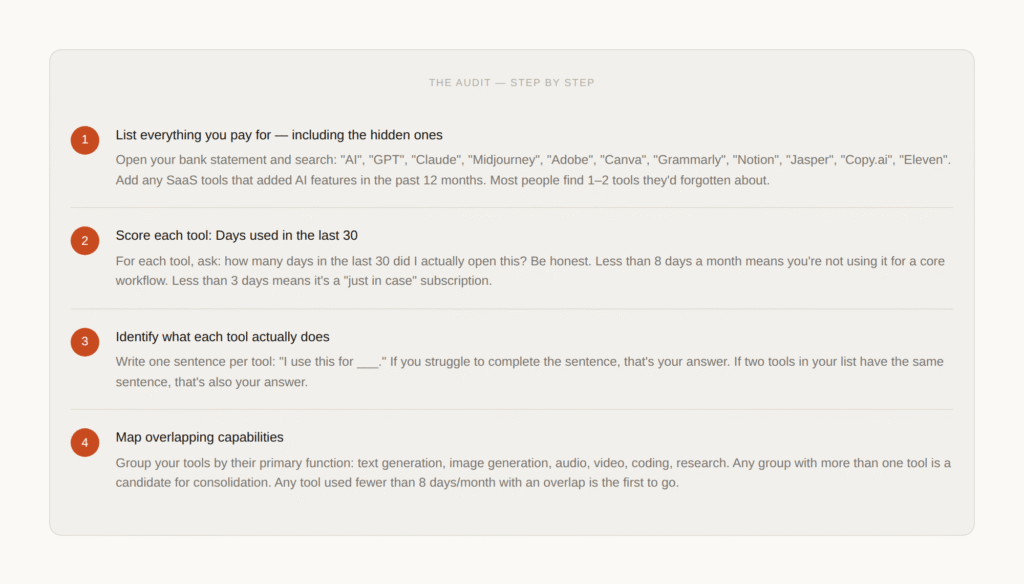
The 10-Minute Stack Audit
The good news is that auditing your AI subscriptions requires approximately the same effort as ordering lunch. Less, actually, because there is no menu paralysis involved. Here is the exact process:
The Decision Matrix: Keep, Consolidate, or Cancel
Once you have done the audit, you will have three types of tools in front of you. Here is how to categorise them quickly, without spending forty-five minutes deliberating over a €8/month tool that you last opened in February.
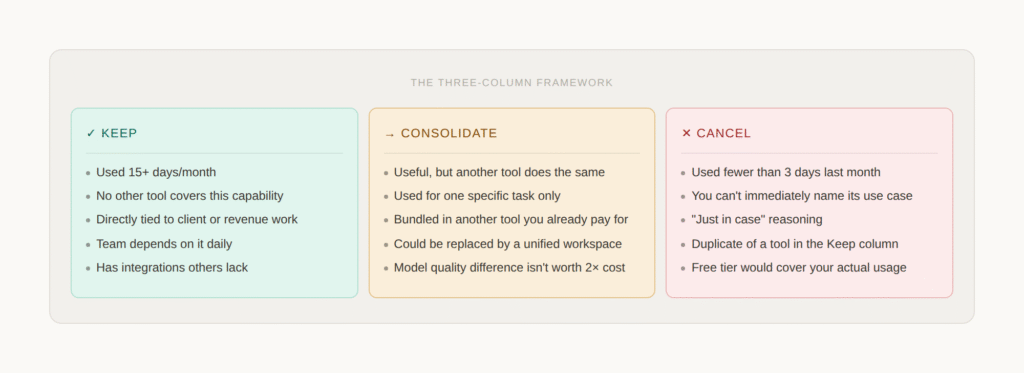
The most common result from running this exercise: one definite Keep (usually the tool you reach for without even thinking), two or three Consolidates (perfectly good tools that just happen to do the same thing as the first one), and one Cancel hiding in plain sight.
What to do with the Consolidates is where it gets interesting. The traditional answer is to pick the best one and cancel the others. The more practical answer, if you are genuinely using different models for different tasks, is to find a single workspace that gives you all of them under one subscription. Which, yes, is exactly what Qolaba does. We are aware this sounds self-serving. The maths still works out regardless of which platform you use: paying for six subscriptions to access six models when one platform gives you all six is not a strategy. It is just arithmetic with extra steps.
The goal is not fewer AI tools. The goal is fewer invoices for the same capability. There is a difference, and it is worth approximately €396 a year.
What the Average German SMB Could Reinvest with Those Savings
If you cancel or consolidate just two tools from your stack, the median German SMB frees up roughly €33 per month, or €396 per year. That is not nothing. Here is what that actually buys you, framed in terms that are more fun to think about than “AI subscriptions”:
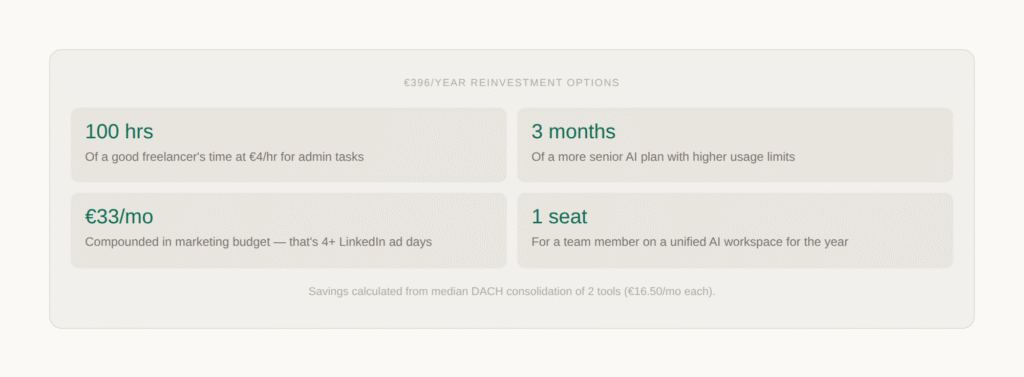
The savings maths is actually quite conservative. DACH users who migrated to a unified AI workspace reported reducing their total AI spend by €200 to €500 per month, because they were no longer paying for access to each model separately. The consolidated model (one credit system, all tools) simply costs less than the à la carte version, the same way a data plan costs less than paying per text message. Remember those days? Wonderful. Anyway.
More importantly, consolidation has a second-order benefit that does not show up in the monthly cost calculation. When your AI tools are in one workspace, your context travels with you. You are not re-explaining your brand voice to three different tools. You are not copy-pasting between tabs like it is 2019. You are not maintaining three separate prompt libraries that all say slightly different things. That time you save is harder to put a number on, but it adds up faster than the euros, and it does wonders for your blood pressure.
Frequently Asked Questions
How much do German SMBs actually spend on AI tools per year?
Based on Qolaba’s DACH cohort analysis of 1,822 businesses, the median is €936 per year. A significant portion of that (around 40%) goes to tools used fewer than three times a month. The average active spend for tools used weekly sits closer to €540. The other €396 is, charitably speaking, an optimism fund.
Is it worth keeping both ChatGPT Plus and Claude Pro?
For most business use cases, no. Both are large language models handling the same core tasks: writing, analysis, coding, summarisation. Unless you are actively testing model output quality or have a workflow that genuinely requires the specific strengths of each (Claude for long documents, ChatGPT for integrations), maintaining both doubles your text generation cost without meaningfully doubling your capability. It is like paying for two search engines. Both work. You only need one.
Is using a personal AI subscription DSGVO compliant for German businesses?
Personal consumer accounts of most major AI tools do not come with a data processing agreement (Auftragsverarbeitungsvertrag / AVV). Using a personal AI account for work involving customer data likely creates liability under DSGVO Article 83. Business and enterprise tiers typically offer AVVs, as does Qolaba. If your team is currently using personal accounts for client work, that is a compliance issue worth fixing regardless of the cost conversation. German regulators are thorough.
What is Qolaba and how does it consolidate AI costs?
Qolaba is a unified workspace that gives you access to 60+ AI models including ChatGPT, Claude, Gemini, DALL-E, image editing, and video generation tools, all under a single transparent credit-based pricing model. DACH users replacing 4 to 6 tools reported saving €200 to €500 per month. No annual contract. 400 free credits to start. No, we will not make it difficult to cancel.