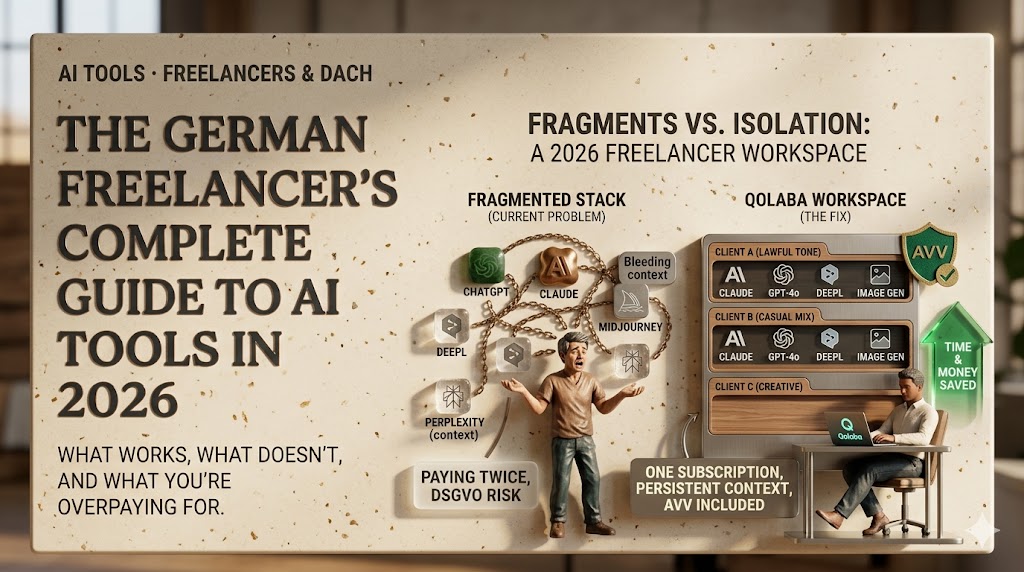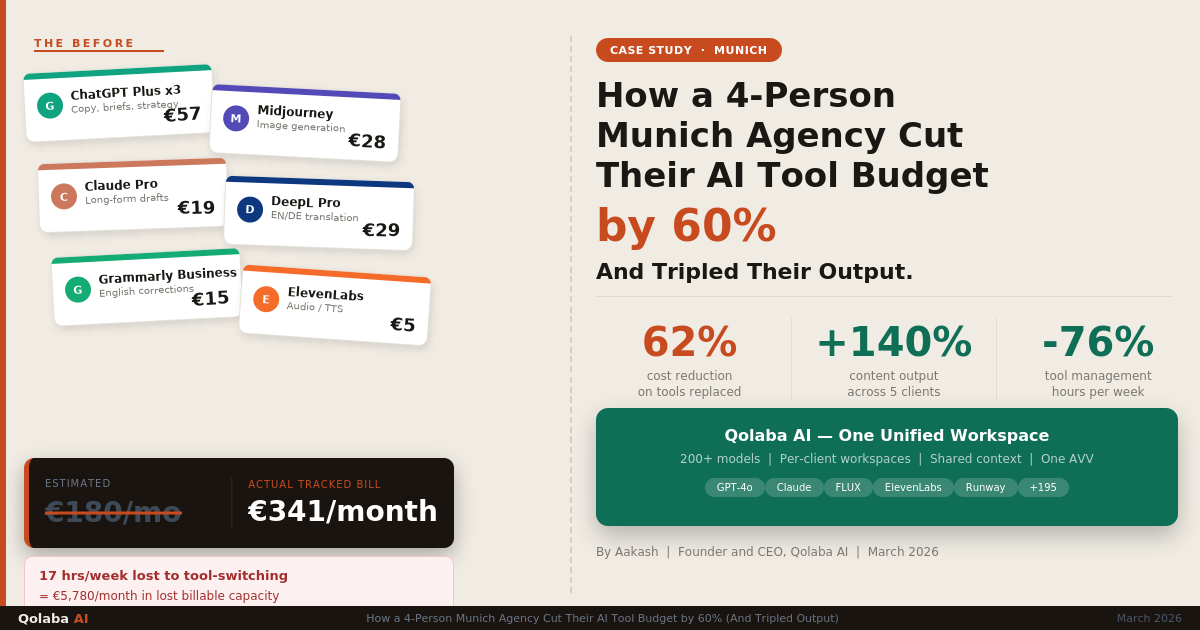


Germany has among the most productive knowledge workers in the world. So it is worth asking: why are so many German professionals — founders, consultants, agency owners, team leads — quietly losing hours every week and hundreds of euros every month to a problem they never consciously chose?
The answer is AI tool fragmentation.
Based on Qolaba’s analysis of 1,822 German and DACH professionals, the average knowledge worker subscribes to 4.2 separate AI tools and actively uses 1.8 of them. The rest idle — billed, forgotten, occasionally opened, never fully utilized.
Here are the five ways that stack is costing you.

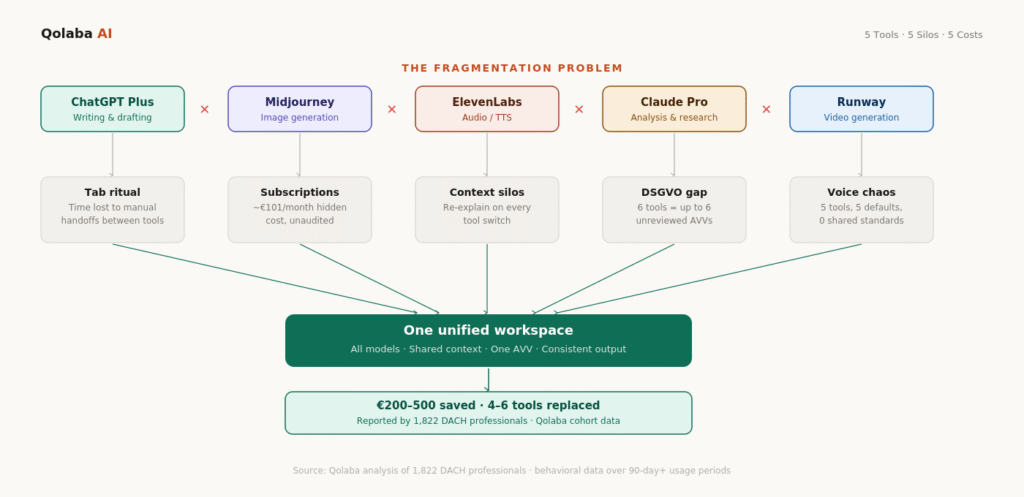
The Morning Tab Ritual — How Fragmentation Steals Your First Hour
A marketing manager at a B2B software company in Munich starts her day by opening six tabs: ChatGPT for copy, Midjourney for visuals, Grammarly for corrections, DeepL for German localization, a scheduling platform, and a shared Google Drive folder that the team uses to track approvals — imperfectly.
The problem is not that any individual tool is difficult. The problem is that they are completely isolated from each other.
ChatGPT does not know what was designed in Midjourney. The scheduler knows nothing about either. Every handoff between tools is manual: copy the output, paste it into the next platform, reformat, re-enter context. Each transfer is a small friction point. Across a full workday and a full team, they add up to a measurable and unnecessary overhead.
There is also the cognitive cost of re-orienting across distinct interfaces — different defaults, different conventions, different ways of working — every time you switch.
A single workspace where every model is accessible and outputs flow directly into the next step eliminates this entirely.
The Subscription Audit Nobody Does – The Hidden Cost of “Just €20 a Month”
An independent Unternehmensberater in Frankfurt is sharp with client finances — but has not looked at his own AI software spend in eighteen months.
Here is what a typical multi-tool stack costs at current standard plan pricing:
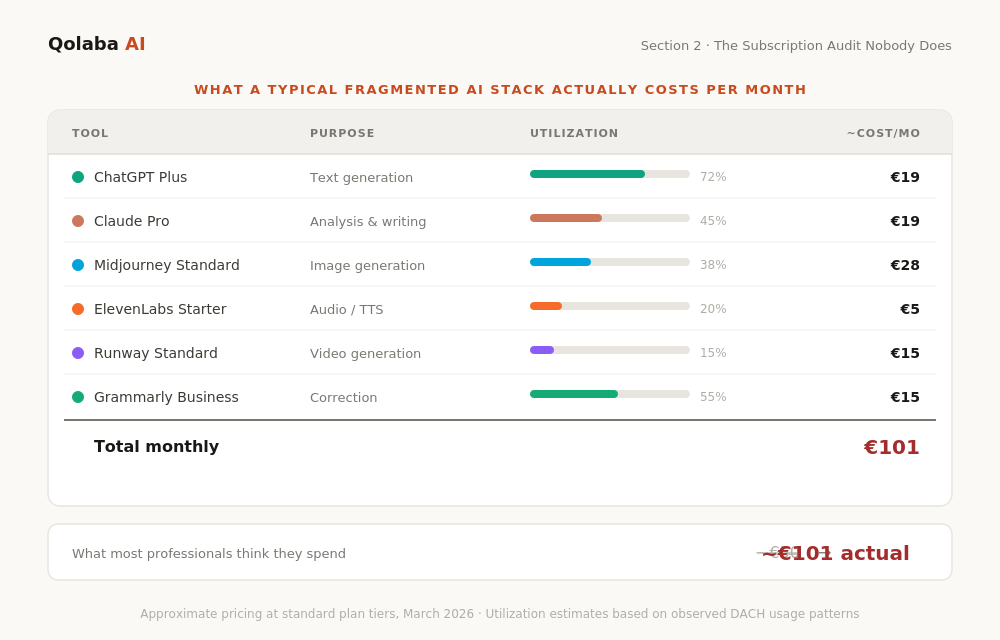
Most professionals estimate they spend around €50. They are not lying — charges arrive across different cards, currencies, and billing dates throughout the month. Each renewal is a small, forgettable debit.
Add the utilization problem: splitting focus across six platforms makes it structurally difficult to develop real fluency with any of them. Full value from an AI tool requires consistent, focused use. Fragmentation makes that impossible.
DACH professionals in Qolaba’s cohort who consolidated reported saving €200–500 per month — not by giving up capability, but by eliminating redundancy and idle subscriptions.
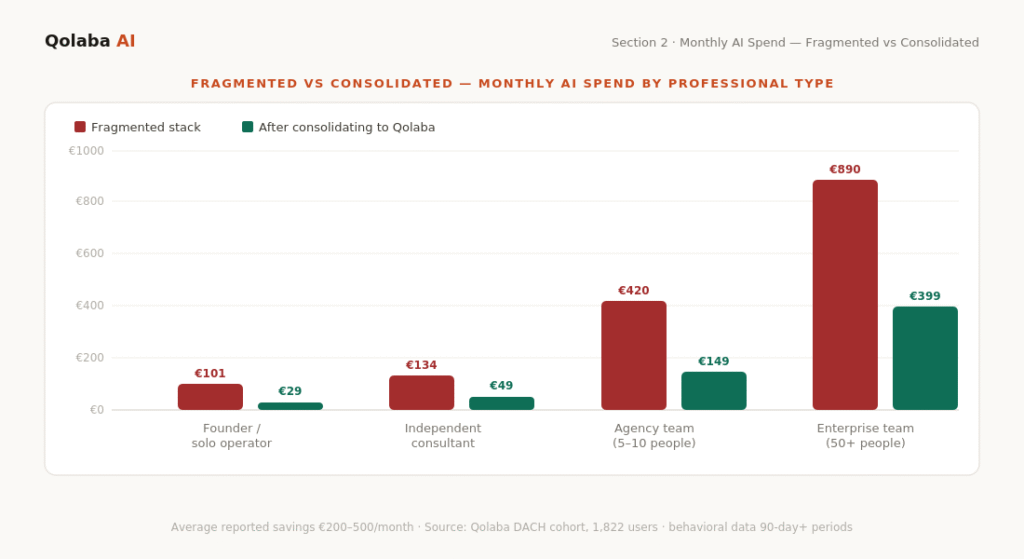
Just €20 a month” is the most expensive sentence in German AI productivity right now.
The Context-Switch Tax — The Mental Load Nobody Measures
A freelance content strategist in Berlin works across four client accounts simultaneously. Each client has a different brand voice, a different formality level in German, different approved content, and different ongoing campaigns.
The problem is not that individual AI tools lack memory — most modern tools do retain conversation history within their own platform. The real problem is that no tool knows what any other tool knows.
When she opens ChatGPT for one task, it has her ChatGPT history for that client. When she switches to Claude for a different task on the same client, Claude has none of it. She re-explains the brand, the tone, the project background — from scratch. When a team member needs to pick up her work, they inherit none of the AI context regardless of which tool was used. It lives in one person’s account, in one tool’s history. It is not transferable.
The more tools in the stack, the more this re-establishment happens. The more clients in the portfolio, the higher the daily cost.
A persistent per-client workspace — where context, guidelines, and history live in one place accessible to everyone — means context is never rebuilt from scratch.tool knows what any other tool knows.
When she opens ChatGPT for one task, it has her ChatGPT history for that client. When she switches to Claude for a different task on the same client, Claude has none of it. She re-explains the brand, the tone, the project background — from scratch. When a team member needs to pick up her work, they inherit none of the AI context regardless of which tool was used. It lives in one person’s account, in one tool’s history. It is not transferable.
The more tools in the stack, the more this re-establishment happens. The more clients in the portfolio, the higher the daily cost.
A persistent per-client workspace — where context, guidelines, and history live in one place accessible to everyone — means context is never rebuilt from scratch.
The DSGVO Ticking Clock — The Compliance Risk Hidden in Your Workflow
A Head of Digital at a Mittelstand manufacturing company in Stuttgart has twelve team members using AI tools regularly for customer communications, internal documentation, and sales materials. Productivity is up. Nobody asked Legal.
Under the Datenschutz-Grundverordnung (DSGVO), inputting personal data into a third-party AI tool constitutes data processing under Article 4. This requires a valid data processing agreement (Auftragsverarbeitungsvertrag, AVV) between the business and the AI provider.
An important nuance: enterprise tiers of major AI platforms do offer AVVs. The compliance risk is that most teams adopt AI tools on personal consumer accounts that are not covered by any organizational data processing agreement. Twelve team members using personal accounts across six different tools means twelve unreviewed data handling relationships — none of which were evaluated when each person individually signed up.
Article 83 of the DSGVO permits fines of up to €20 million or 4% of global annual turnover.

A single platform with a single formally reviewed AVV replaces six separate compliance relationships with one.
The Brand Voice Chaos — When Five Tools Speak in Five Different Voices
A Geschäftsführerin running a digital agency in Hamburg has nine clients and a team of six. Each person uses their preferred tool: one uses Claude, one uses ChatGPT, one uses Midjourney, one uses Runway. No shared prompt library. No shared brand standard.
The output is technically competent but not coherent.
Client A’s blog posts sound like a different company than their social captions. Client C’s German copy alternates between du and Sie in the same month. Each individual output looks acceptable in isolation. The incoherence only appears when pieces are placed next to each other — which is exactly when the client sees them.
Two to three hours per week go into reconciling this. Clients rarely complain explicitly. They just feel something is off. That feeling compounds quietly until a contract renewal arrives.
Shared workspaces — where brand guidelines, client agents, and approved templates are pre-loaded for every team member — eliminate the variation at the input level, before it reaches the output.
The Pattern Across All Five
A marketing manager in Munich. A consultant in Frankfurt. A content strategist in Berlin. A digital lead in Stuttgart. An agency owner in Hamburg.
The pain points differ in surface form — time, money, mental load, compliance, quality — but the structural cause is the same: multiple tools solving individual problems in isolation, with nothing connecting them.
The cost does not appear in any single line item. It accumulates across manual output transfers, unaudited subscription invoices, repeated context re-establishment, unreviewed data processing relationships, and client feedback that arrives months after the problem began.
What the Data Shows
From Qolaba’s analysis of 1,822 German and DACH professionals — behavioral data from real usage over 90-day+ periods:

Frequently Asked Questions
What is AI tool fragmentation?
AI tool fragmentation occurs when professionals use multiple separate AI platforms — each with its own login, pricing, and data context — instead of a unified workflow. The core problem is the gaps between tools: manual transfers, isolated context silos, separate compliance relationships, and no shared quality standard.
Which German professionals are most affected?
Independent consultants managing multiple client accounts across different tools, agency owners managing team output with no shared standard, SMB founders with distributed teams using different tools, and enterprise team leads with no visibility into which AI tools their direct reports are using.
How does fragmentation create DSGVO risk?
Most employees adopt AI tools on personal accounts not covered by organizational data processing agreements. A team using six AI tools on personal accounts has potentially six unreviewed data handling relationships. One platform with one formally reviewed AVV reduces this to one.
What is the average cost of AI tool subscriptions for German professionals?
A typical five to six tool stack costs approximately €80–110 per month — roughly double what most professionals estimate. After consolidating, DACH users in Qolaba’s cohort reported saving €200–500 per month.
What is Qolaba?
Qolaba is an AI Operating System — a unified workspace consolidating 200+ AI models including GPT-4o, Claude, Gemini, Midjourney, FLUX, ElevenLabs, and Runway into a single credit-based platform. Persistent workspaces, custom AI agents, team collaboration, and a data architecture built for DSGVO-compliant business use. 285,000+ users across 60+ countries.
What Comes Next
Over the coming weeks this blog will publish practical resources for German professionals navigating the AI fragmentation problem: a DSGVO checklist for AI tool adoption, a 15-minute subscription cost audit, agency workflow case studies, and consultant workflow guides.
If any of the five situations above reflected your own workflow, the most direct next step is to see whether a consolidated workspace changes your experience.