

The difference between a mediocre market research report and a brilliant industry analysis often comes down to asking the right questions. In the age of AI-powered research tools, your ability to craft precise, comprehensive prompts has become a competitive advantage.
Yet many professionals struggle to extract meaningful insights, receiving generic overviews when they need actionable intelligence. The problem isn’t the AI’s capabilities—it’s the prompting strategy.
This guide will show you how to craft sophisticated market research prompts that generate comprehensive industry analyses, transforming raw information into strategic insights.
Core Components of Effective Market Research Prompts

1. Industry Definition & Scope
Begin by clearly defining the industry parameters. Vague definitions lead to unfocused analyses.
Basic Prompt: “Tell me about the electric vehicle industry.”
Enhanced Prompt: “Analyze the passenger electric vehicle market in North America, focusing on vehicles priced between 30,000-50,000. Include both established automakers and new entrants, but exclude commercial fleet vehicles and electric motorcycles.”
The enhanced prompt establishes clear boundaries, ensuring the analysis remains relevant to your specific needs.
2. Competitive Landscape Mapping
Move beyond simple competitor lists to understand strategic positioning.
Enhanced Prompt: “Map the competitive landscape of the meal kit delivery service industry in urban U.S. markets. Categorize competitors by: 1) price point, 2) positioning (health-focused, convenience, gourmet), 3) market share trends over the past 24 months, and 4) key differentiators in their business models.”
This structured approach delivers actionable competitive intelligence rather than just a list of names.
3. Trend Identification & Analysis
Uncover patterns and shifts that signal where the market is heading.
Enhanced Prompt: “Identify the 5 most significant emerging trends in B2B digital marketing for enterprise software companies. For each trend: 1) explain the core strategy, 2) provide adoption evidence, 3) analyze which companies are early adopters, 4) estimate implementation complexity, and 5) predict evolution over the next 18 months.”
This prompt generates forward-looking insights with practical considerations.
4. Market Sizing & Growth Projections
Get beyond vague growth claims to understand true market potential.
Enhanced Prompt: “Provide a detailed market sizing for the U.S. telehealth industry, segmented by: 1) primary care vs. specialty services, 2) direct-to-consumer vs. provider-enabled models. Include current market value, historical CAGR (2018-2023), and projected growth through 2028. Identify the fastest-growing segment and explain key drivers.”
This approach delivers granular data you can actually use in business planning.
5. Regulatory & Barrier Analysis
Understand the rules of the game and obstacles to entry.
Enhanced Prompt: “Analyze the regulatory landscape for consumer lending fintech startups in the European Union. Include: 1) key EU-wide regulations, 2) significant country-specific variations, 3) compliance costs for new entrants, and 4) which regulatory trends could create opportunities or threats in the next 3 years.”
This prompt delivers a nuanced understanding of regulations as both constraints and potential opportunities.
Advanced Prompting Strategies

The Comparative Analysis Framework
Prompt Example: “Compare SaaS customer acquisition strategies in the project management market vs. the CRM market. Analyze: 1) typical CAC, 2) effective marketing channels, 3) sales cycle length, and 4) retention strategies.”
The Contrarian Perspective Prompt
Prompt Example: “Identify 3 widely accepted ‘truths’ about the home fitness equipment market that may be incorrect. For each: 1) describe the conventional belief, 2) present contradicting evidence, and 3) explain how a company could gain advantage by acting counter to conventional wisdom.”
Practical Implementation
- Start with a Research Brief: Define what you need to learn and why.
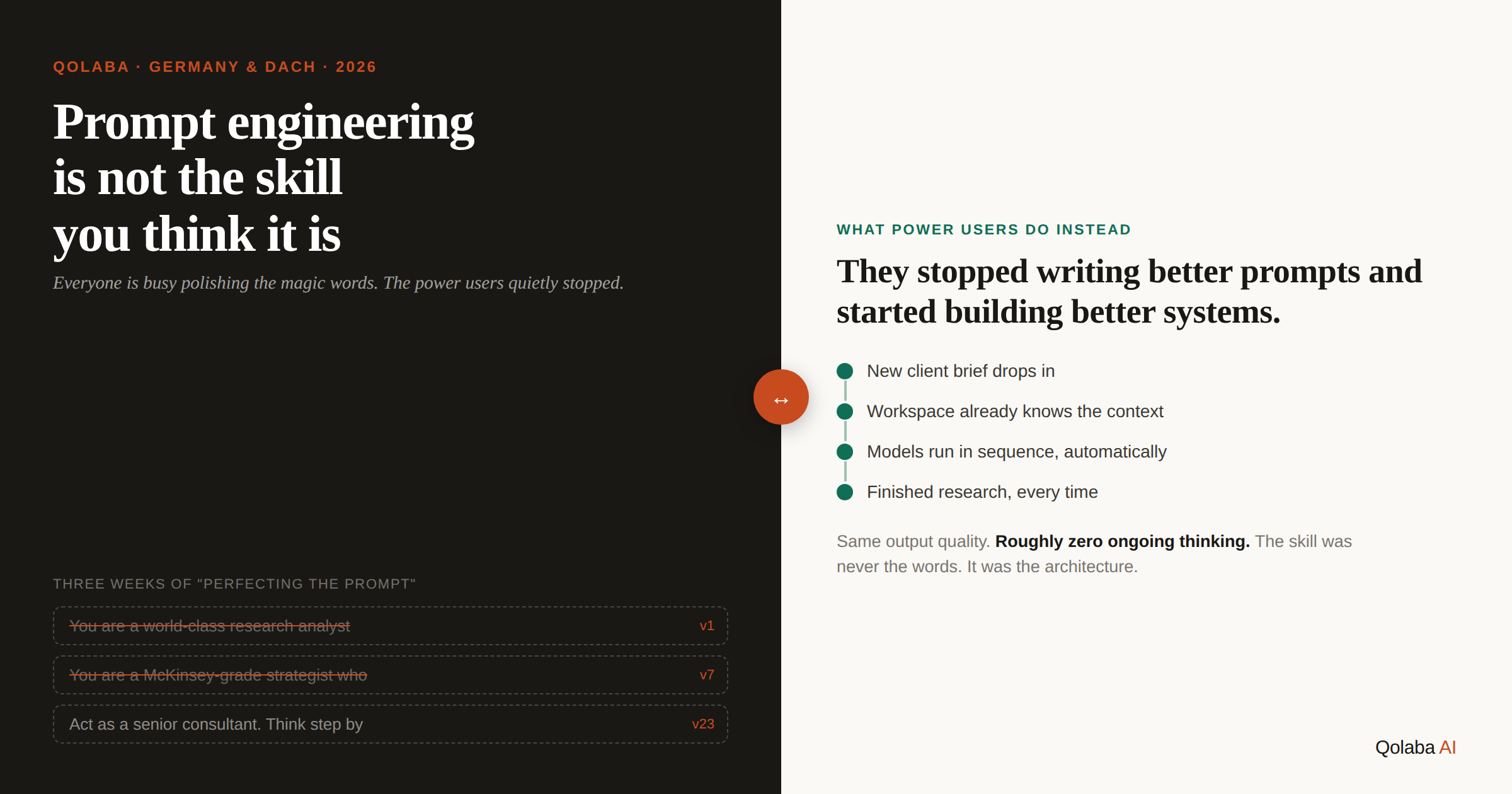
- Build Modular Prompts: Break complex research into a sequence of focused prompts.
- Iterate Based on Results: Use initial responses to refine subsequent prompts.
- Validate Multiple Sources: Cross-check key findings using different approaches.
- Synthesize into Action: Transform analysis into recommendations with a final synthesis prompt.
Transform your market research capabilities with Qolaba‘s unified AI workspace. Create, store, and refine your most effective research prompts as reusable templates, ensuring consistent, high-quality industry analyses across your organization. From competitive analysis to trend identification, Qolaba helps you develop the strategic insights that drive business growth and market leadership.