
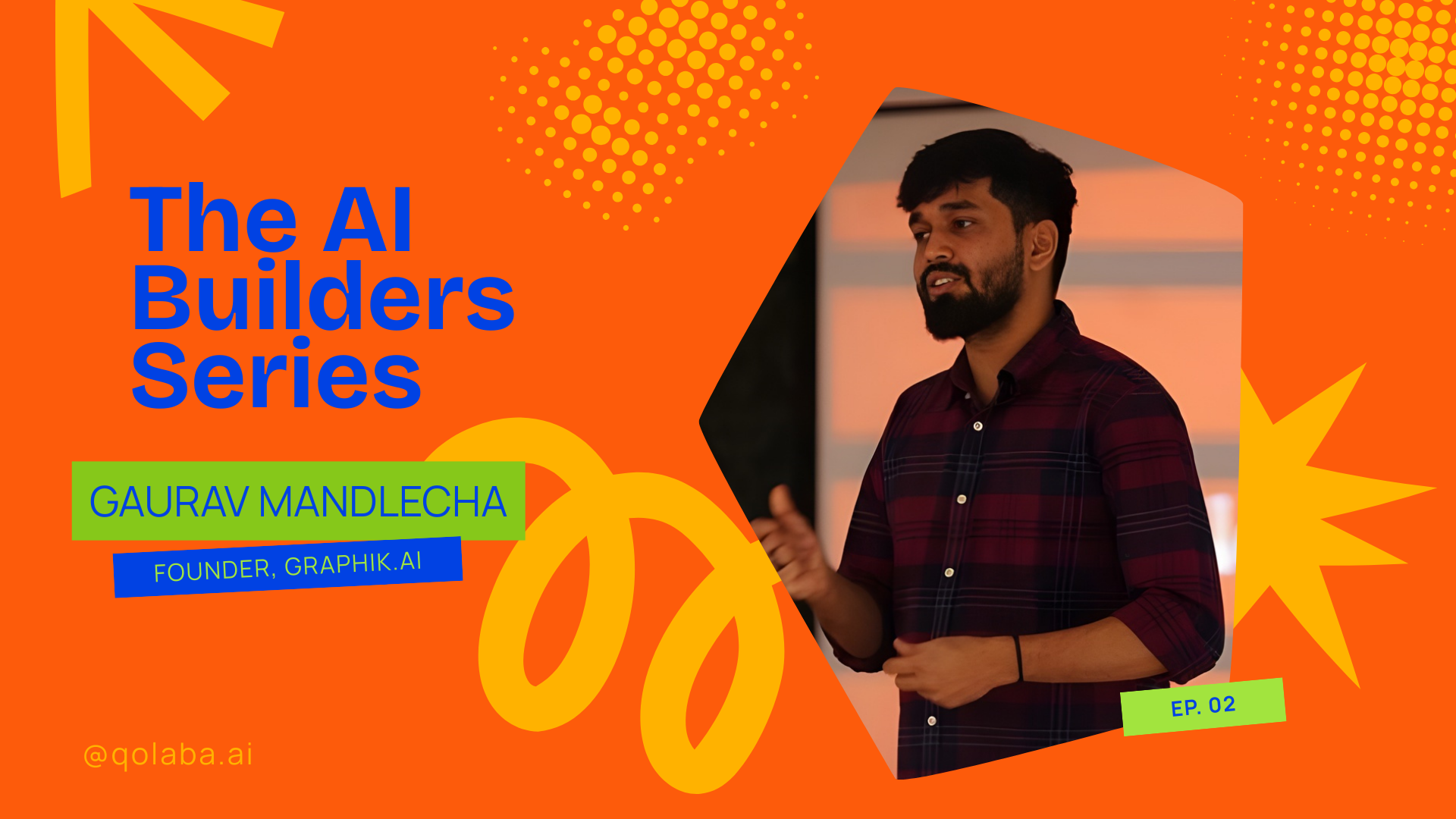
Gaurav Mandlecha’s career reads like a masterclass in ecosystem building. From early-stage operator roles at high-growth startups to evaluating deals at Tanglin Venture Partners, from co-authoring a book on founder journeys to now building AI solutions for financial institutions with Graphik AI—his path reflects a unique synthesis of technology, capital, and community.
As someone who describes himself as one who “connects dots and creates plots,” Mandlecha brings a multifaceted perspective to the AI revolution. In this exclusive interview for Qolaba’s AI Builder Series, he shares insights on building AI-native organizations, the convergence of AI and financial services, and why the next wave of innovation lies in domain-specific solutions.
The Convergence of Multiple Vantage Points
Mandlecha’s journey through startups, venture capital, and content creation has fundamentally shaped how he approaches building Graphik AI. “Each of these experiences has shaped how I approach building, and honestly, it’s still very much a work in progress,” he reflects.
From his startup experiences, he learned to embrace uncertainty as freedom rather than constraint. “You experiment constantly, face rejection regularly, and iterate relentlessly toward product-market fit,” he explains. But the real lesson was maintaining clarity on two fundamentals: who you’re solving for and what specific pain points you’re addressing.
His time in venture capital provided a different lens—understanding what it takes to build venture-scalable businesses across different stages. “I learned to read between the lines in investor conversations, understand what signals matter, and recognize patterns in what works and what doesn’t,” Mandlecha notes. This perspective enables him to think about scale from day one, not just solving immediate problems.
The storytelling muscle developed through writing and content creation proved equally valuable. “I genuinely believe in the power of stories to simplify complexity and connect with people,” he says. This ability to communicate clearly becomes crucial when explaining AI to non-technical stakeholders or building community.
For financial institutions specifically, this convergence feels natural. “Financial institutions have unique needs: they’re risk-averse, heavily regulated, and require solutions that are not just innovative but also reliable and explainable,” Mandlecha explains. His combined experiences help bridge the gap between cutting-edge AI capabilities and institutional requirements.
Living the AI-Native Reality
When Mandlecha talks about AI-native operations, he doesn’t speak in abstractions. “Let me give you a very real example—this interview itself,” he shares. “Right now, I’m using Wispr Flow to capture my thoughts as a stream of consciousness, and then I’m using Claude to refine and structure those thoughts into a polished response.”
At Graphik AI, this philosophy permeates every aspect of operations. The company has embedded a simple question into everything they do: “How can we make this more efficient using AI?” With a policy of unlimited AI tool subscriptions, every team member is encouraged to experiment and find what works for their workflow.
“We believe this is going to be our right to win,” Mandlecha asserts. “If we, as a team, become exceptionally proficient with AI, we’ll consistently outpace traditional teams simply by being more efficient.”
But he’s candid about the balance required. “The key is not substituting your thinking with AI, but treating it as a highly capable co-pilot, assistant, or intern working alongside you.” At Graphik AI, humans own the strategy, client relationships, and most importantly, the accountability. “The buck stops with a person, not a model. That person is responsible for the final quality, the decisions, and the outcomes.”
Transforming Connection Through Preparation
Mandlecha’s approach to community building has been revolutionized by AI tools, though not in the way one might expect. Before meeting anyone, he uses tools like Exa AI for deep web search and Parallel (from former Twitter CEO Parag Agrawal) to research individuals comprehensively.
“Instead of spending the first 15 minutes on surface-level small talk, we jump straight into substantive conversation,” he explains. The AI helps discover connection points that would never surface through manual research—not because the information wasn’t available, but because there simply wouldn’t be time to find it.
Yet Mandlecha is clear about AI’s role: “AI didn’t build the relationship, it gave me the context to show up more prepared and present. Real community building still comes down to human intuition, genuine curiosity, and authentic connection.”
This approach has fundamentally shifted his networking philosophy. “It’s not about collecting contacts, it’s about creating meaningful connections, and AI has become an invaluable tool in making those connections more intentional and substantive from the very first conversation.”
The Next Wave: Domain-Specific Disruption
Drawing from his dual perspective as investor and operator, Mandlecha sees distinct opportunities in both B2B and B2C spaces.
For B2B, the playbook is straightforward but execution-intensive. “Pick an industry, identify a specific workflow, and spend time—real time—with customers understanding where the inefficiencies are,” he advises. The key is then applying AI modalities—LLMs for reasoning, voice for interaction, vision for documents—to dramatically improve that workflow’s efficiency.
He makes an important distinction: “There’s AI on top of existing software, and then there’s AI-native software built from the ground up. These are two fundamentally different opportunities. The former is incremental; the latter is disruptive.”
For B2C, Mandlecha thinks through the lens of “dopamine optimization.” With generative AI’s ability to create infinite, personalized content, the opportunity lies in identifying dopamine loops—whether learning, feeling understood, or being entertained—and delivering uniquely personalized experiences.
The overlooked opportunity for Indian founders specifically? “Domain-specific AI for Indian contexts—whether that’s vernacular language models, AI for compliance in Indian regulatory frameworks, or document intelligence for unstructured Indian documents,” Mandlecha suggests. “Most founders are chasing horizontal plays, but the real value is in going deep into contexts where global models fall short.”
Building for the Long Game
Gaurav Mandlecha’s journey from observing patterns across the startup ecosystem to building AI solutions represents a new breed of founder—one who combines operational excellence with strategic thinking, technical capability with human insight.
His belief in “small, compounding actions” and strong ecosystems reflects in how Graphik AI operates: not as a company chasing AI hype, but as one methodically building durable solutions for an industry that demands both innovation and reliability.
As AI continues to reshape every industry, Mandlecha’s insights offer a pragmatic roadmap: embrace AI as a capability accelerator, maintain human accountability, prepare deeply for meaningful connections, and focus on domain-specific problems where generic solutions fall short. For those building in the AI era, his message is clear: the future belongs not to those who replace human judgment with AI, but to those who amplify human capability through thoughtful AI integration.
This interview is a part of Qolaba’s AI Builder Series featuring thought leaders who are showcasing innovation and driving change with AI.
Gaurav Mandlecha is the founder of Graphik AI, building AI solutions for financial institutions. He is also an angel investor, author of Pilani Pioneers, and writes extensively about AI-native teams, startup execution, and business models on LinkedIn and social platforms.