
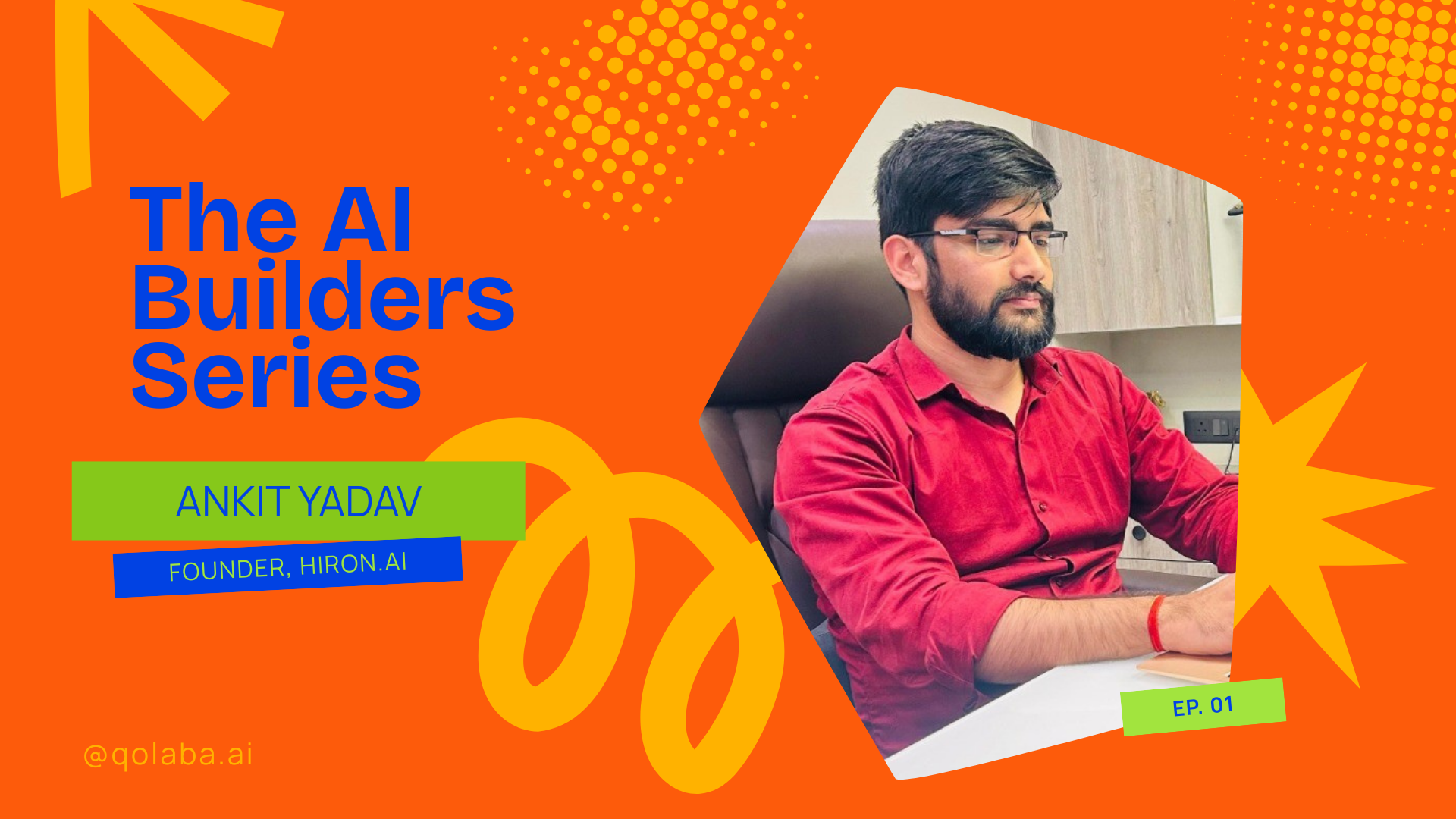
When Ankit Yadav built Hiron AI, an AI-driven hiring ecosystem that reimagined candidate discovery, he didn’t just create another AI tool. He built a product that challenged decades of recruitment conventions, ultimately leading to a successful acquisition. Now, as a product-first AI builder and mentor, Yadav helps teams navigate the complex intersection of AI innovation and practical product development.
In this exclusive interview for Qolaba’s AI Builder Series, Yadav shares hard-won insights from the trenches of AI product development, from the critical pitfalls that derail promising projects to the nuanced challenges of building trust in AI-driven systems.
AI Is Not the Product, It’s the Enabler
One of the most dangerous assumptions in AI product development, according to Yadav, is treating AI as the product itself. “In reality, AI is only an enabler,” he emphasizes. “The product still lives or dies on clarity of problem definition, data quality, and user trust.”
Yadav identifies two patterns that repeatedly surface in failing AI projects:
- The Data Reality Gap: Teams often design ambitious AI systems based on hypothetical future datasets rather than current realities. “Startups design technically impressive systems that fail in the real world,” Yadav notes. His approach? Stress test the data first. Can the model deliver consistent value with the data available today—not tomorrow’s perfect dataset?
- The Unglamorous Edge Cases: While teams focus on core AI capabilities, products often break at the edges—ambiguity handling, error recovery, and user guidance. “The most resilient AI products we’ve built handle uncertainty transparently, explain why they made certain predictions, and offer clear fallback paths,” Yadav explains. These “boring but critical” micro-interactions often determine whether users trust and adopt the system.
Reimagining Professional Identity: The Technical and Behavioral Challenge
Hiron AI’s vision of a resume-less hiring ecosystem presented unique challenges that went beyond technical complexity. “Every candidate expresses their professional identity differently,” Yadav explains. Building systems that could parse, normalize, and semantically represent diverse experiences required extensive data modeling and continuous retraining—all while maintaining an intuitive user experience.
But the deeper challenge was behavioral. “We had to shift decades of learned habits while keeping the experience frictionless,” he reflects. In a trust-deficit environment where users are accustomed to traditional resume-driven workflows, asking them to trust an AI-driven system demanded exceptional transparency.
The solution? Design flows where candidates understand exactly why the platform recommends certain roles and how their data is interpreted. “The challenge wasn’t just technical, it was behavioural,” Yadav emphasizes.
Building Fairness Into the Foundation
For global job matching systems, fairness and privacy cannot be afterthoughts. Yadav’s team approached these challenges with three foundational principles:
- Bias-Aware Data Pipelines: Every training dataset undergoes rigorous auditing for demographic, geographic, and role-level biases. Models are stress-tested across groups and corrected using counterfactual and balanced sampling techniques, ensuring recommendations don’t inadvertently favor certain backgrounds or locations.
- Privacy by Design: User profiles are processed with anonymization and attribute-level permissions. “Sensitive traits are never used in matching logic, and personal identifiers are decoupled from the ranking system,” Yadav explains. Candidates maintain full control over what employers can see.
- Transparent Explainability: Every match includes interpretable signals—skills, intent, experience patterns—so both candidates and employers understand the reasoning behind recommendations. As Yadav puts it: “Transparency is the antidote to distrust.”
The Art of Early-Stage Prioritization
In the fast-paced world of AI startups, Yadav has developed a disciplined approach to feature prioritization that cuts through the noise. “Speed alone doesn’t win—clarity wins,” he states.
His framework centers on three critical questions:
- What is the single moment of value the user must experience in 30 seconds? Identify the “first magical action” and build only what accelerates that moment. Everything else is noise.
- What is the smallest AI capability that proves the core promise? Rather than launching fully autonomous systems, start with the most constrained version that reliably works. This builds both user confidence and valuable data for iteration.
- What grows learning velocity? Prioritize features that accelerate understanding of user behavior, intent, and data quality. “AI products improve through feedback loops, so anything that accelerates learning rises to the top,” Yadav explains.
Looking Forward: Product-First Discipline in an AI-First World
Ankit Yadav’s journey from founding Hiron AI to mentoring the next generation of AI builders reveals a fundamental truth: successful AI products aren’t built on technical prowess alone. They require product-first discipline, deep user empathy, and an unwavering commitment to building trust through transparency.
As AI continues to reshape industries, Yadav’s insights offer a roadmap for builders navigating this complex landscape. His message is clear: focus on the problem, respect the data reality, handle the edges with care, and never forget that behind every AI interaction is a human seeking value, understanding, and trust.
For those following Yadav’s “from the trenches” playbooks on LinkedIn, where he’s recognized as an AI product management influencer, these principles aren’t just theory—they’re battle-tested strategies from someone who’s successfully taken AI products from zero to acquisition.
This interview is a part of Qolaba’s AI Builder Series, featuring thought leaders who are showcasing innovation and driving change with AI.
Ankit Yadav specializes in taking AI products from zero to one, combining user-centric research, product thinking, and hands-on technical execution. He mentors engineers, early-stage founders, and product builders on designing better products with tight execution and a ruthless focus on value.